
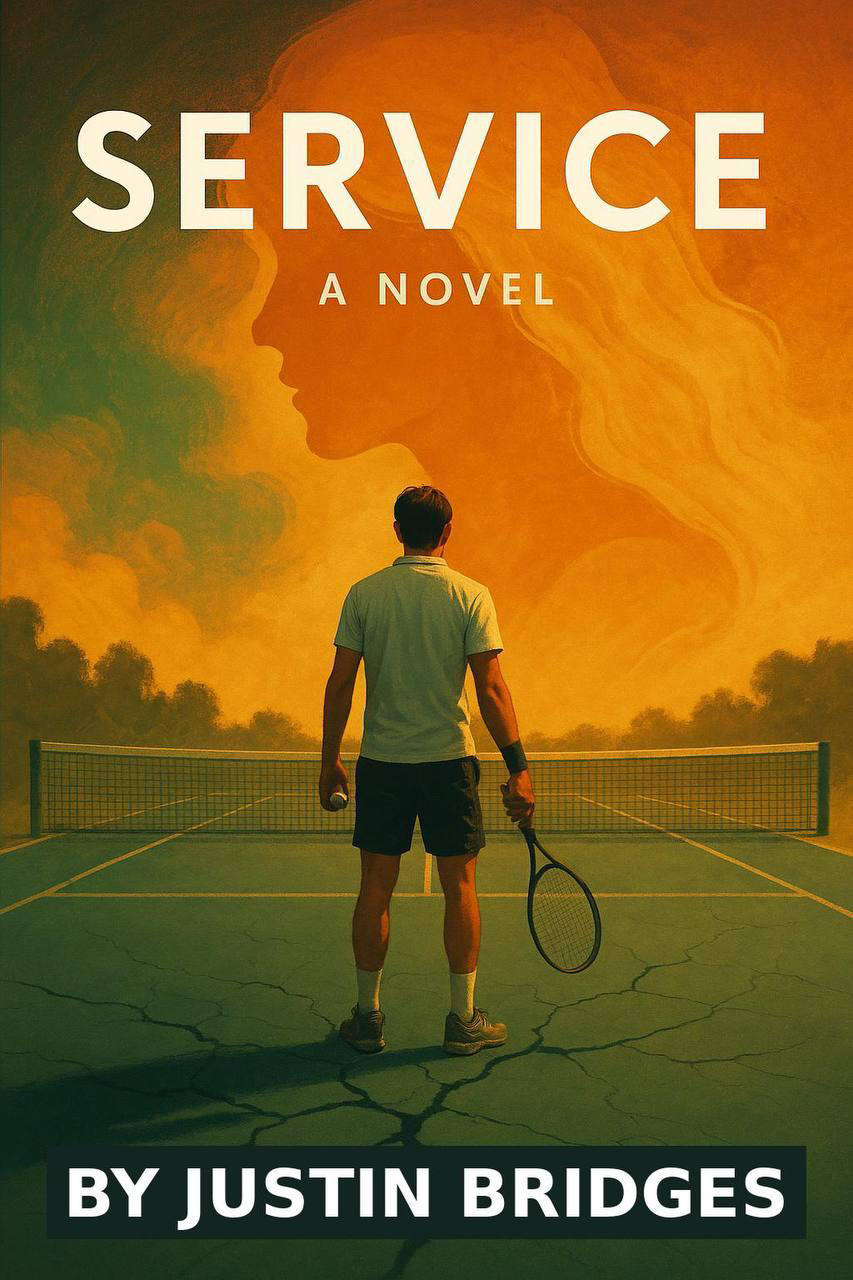

Every development cycle gets its contenders, but once in a blue moon, a piece of material doesn’t merely arrive — it detonates. Service, the pseudonymous debut by “Justin Bridges,” roars with character, conflict, desire, and high emotional voltage. This is that once-in-a-decade novel: fully formed, inherently visual, psychologically surgical, and built with such scene-by-scene precision that it feels preordained for adaptation.
At first glance, it’s the story of Josh — a tennis pro spiraling through romantic calamity, addiction, ambition, and a backlog of unhealed wounds. Imagine Shampoo or American Gigolo reimagined through a Jungian psychological lens — a modern myth about desire, projection, and the shadow self — then narrated with the wounded musicality of Sophie’s Choice and the neurotic wit of Annie Hall.
But as the narrative plunges into places long overdue in American storytelling, it becomes clear that the book’s hot, fast, funny, dark, emotionally volatile energy is the bait — the addictive, binge-worthy surface — for something deeper and more revelatory.
Bridges writes with the timing of someone who understands how scenes actually work: how to escalate tension, meter revelation, and slide emotional subtext beneath physical action. Heat-drenched yoga rooms, backstage Broadway corridors, suburban kitchens where truth detonates without warning, dawn-lit tennis courts buzzing with ambition and danger — each moment reads like a sequence already framed through a lens.
The irony is that this incendiary story began not as a novel but as a journal of “morning pages” written by a recovering addict trying to survive the dark early days of withdrawal from addiction. “Thirteen years later,” The Village Voice review says, “those scraps hardened into a book that is comedy with blood on its shirt, where intimacy is portrayed as a battlefield.”
A Novel That Defies Categorization — Yet Feels Uncannily Familiar
Service refuses to sit neatly in any genre. It’s not derivative, yet it carries the emotional DNA of stories audiences return to again and again. It has the soul of Good Will Hunting, the award-caliber character architecture of Silver Linings Playbook, the heat of Fifty Shades, and the redemptive lift of Eat Pray Love — with the crackling dialogue of As Good as It Gets. Nostalgic yet startlingly fresh, it’s the rare novel that could earn a cult following among development readers while still appealing to mainstream streaming audiences.
Why Talent Will Circle This
The characters — especially the women — are multidimensional, castable, and emotionally alive. Joyce, the housekeeper and street-smart guardian of two motherless boys; Brooke, the Broadway actress with edges sharp enough to glint; Madison, the prodigy whose precocity masks genuine fragility; Karen, the elegant matriarch simmering with unrest — each reads like the blueprint for a career-defining performance.
And then there’s Josh: seductive and pathetic, funny and wounded, dangerous and childlike, self-destructive yet capable of startling clarity. It’s the kind of role actors dream of when they crave something that stretches them. As Vanity Fair put it: “Bridges portrays men as the new dependents, clinging to female strength the way a drowning man clings to driftwood.”
Directors Will Notice Too
The material’s emotional voltage — a fusion of raw comedy, erotic tension, psychological collapse, childhood trauma, cultural critique, and a final act of spiritual reckoning — offers a playground tailor-made for filmmaker-driven projects.
Hollywood’s oldest laments — There are no great scripts left to find and Everything’s already been done — evaporate in the presence of material like this. Like the shepherd’s search for a lost goat that accidentally unearthed the Dead Sea Scrolls, Service arrives anonymously and unexpectedly, a revelation hidden in plain sight.
The Voice, the Mystery, the Movement
Part of the novel’s force comes from the voice itself — funny, fast, erotic, unguarded, emotionally truth-tuned. Imagine Holden Caulfield’s raw interiority, but with a distinctly modern, spiritually bruised edge.
The author’s anonymity only heightens the mystique. Even J.D. Salinger gave the world his name before disappearing; Bridges choosing total anonymity. Not even a trail of bread crumbs anywhere leads back to the writer’s true identity. That itself is especially appealing in an age of overexposed stars and aspiring stars screaming their names from every mountaintop and social media platform available. The messenger may be invisible, but the message is unforgettable: Service is not just the launch of a writer. It’s the ignition of a movement.
In 2020, Bridges launched free daily online 12-step meetings for recovering sex and love addicts that now run five times a day. Over one million men have attended around the world — a true revolution in the sexual and emotional behavior of men. It’s as if the worlds of Nabokov, Jung, and the modern recovery movement collided — not to co-write, but to provoke, argue, refine, and expand each other.
The Thematic Spine That Gives It Prestige Weight
What elevates Service beyond its irresistible storytelling is the idea pulsing beneath it: Bridges dismantles one of culture’s most seductive myths — the belief that romantic partners hold the key to salvation. Hollywood has built empires on this fantasy. Yet here comes a novel treating that ideology as spiritual malpractice.
Josh’s revelation — after rescuers, seductresses, dream girls, soulmates, and mother figures all fail to fill the void — is devastating in its simplicity. He is consumed by a spiritual virus, one that both rules him and drains him, yet he tries to quench his thirst by drinking salt water.
Bridges lures in the audience with vulnerability, humor, erotica, spiritual depth, family dysfunction, and wish fulfillment, only to take them somewhere fiction rarely goes. It’s a thrill ride that shoots through a wormhole into another dimension, a place that feels both unexpected and inevitable.
The book’s most incisive insight is its unflinching exposure of the masculine reflex to seek emotional rescue in the bodies and attention of women. He portrays sex addiction as starting with a body part or sexual act and building an entire relationship outward from it. He portrays love addiction as only feeling valuable if you are valued by another. This story is not about a man being saved. It’s about confronting the abyss inside the desire to be saved at all.
Final Verdict
Service isn’t merely adaptable — it’s the kind of material that generates heat. It possesses the structure, psychology, humor, volatility, castable roles, and thematic heft that provoke creative imagination in the people who make things for a living.
It’s prestige storytelling with popular momentum; raw honesty with cinematic muscle; emotional depth with undeniable entertainment value.
Hollywood won’t overlook this one. And they won’t want to.
Because every now and then, a novel appears that proves both complaints wrong — the myth of script scarcity and the myth of story recycling. Service obliterates both those fallacies in one blow.