
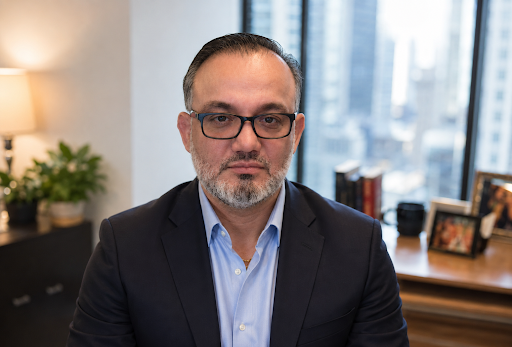

By any traditional measure, Hooman D. Tavakolian has built an impressive life. He has served in leadership roles within the wrestling community, built a successful career in one of the most demanding sectors of the financial industry, founded charitable initiatives that have impacted underserved communities, and used sports as a bridge between cultures often separated by politics and geography.
Yet if you ask him what shaped him most, he is unlikely to mention any of those accomplishments.
He will talk about struggle.
He will talk about failure.
He will talk about the moments when things did not go according to plan.
Because for Tavakolian, success was never built during the easy seasons. It was built during the difficult times.
“I’ve always believed that being the underdog is an advantage,” he says. “When nobody expects anything from you, you’re free to work, learn, and grow without limits.”
That belief has become the foundation of a life defined by grit, gratitude, and an unwavering refusal to quit.
No Shortcuts, No Roadmap
Long before leadership positions, public recognition, and professional success, there was simply a young man trying to find his place in a new country. Like many immigrants, Tavakolian arrived in the United States carrying more ambition than certainty. There were no guarantees waiting for him. No roadmap. No special advantages.
What he did have was a willingness to outwork adversity. The road forward was not always clear. There were setbacks, disappointments, and moments when progress seemed frustratingly slow. There were times when the distance between where he was and where he wanted to be felt impossible to close. But wrestling had already taught him something important.
The match is never over until it is over.
Lessons Learned on the Mat
Before boardrooms and charitable projects, there was a wrestling room. For Tavakolian, wrestling was never simply a sport. It was an education. The sport taught him accountability. It taught him discipline. It taught him that excuses do not change outcomes and that effort is often the only variable fully within your control. It also taught him humility. In wrestling, nobody wins forever. Everyone gets taken down. Everyone experiences defeat. The challenge is deciding what happens next.
Do you stay down?
Or do you get back up?
That lesson followed him long after the competition ended.
The discipline developed through years of training eventually became a blueprint for how he approached life, business, leadership, and service.
Even today, many of the principles he shares with young athletes have little to do with sports and everything to do with character.
Rock Bottom as a Leadership Asset
Like many successful people, Tavakolian’s story is often viewed through the lens of outcomes. People see accomplishments. They rarely see the obstacles.
They do not see the uncertainty, the sacrifices, or the years spent quietly building without recognition. There were moments when setbacks seemed to outweigh progress. Moments when continuing forward required faith more than confidence. But over time, he learned something that would become one of his defining beliefs: Rock bottom is not always a place of defeat.
Sometimes it is a place of construction.
Sometimes life strips away distractions so that stronger foundations can be built. Looking back, many of the experiences that once felt unfair ultimately became valuable teachers. Failures became feedback.
Losses became lessons.
Challenges became preparation. What once appeared to be barriers often turned out to be stepping stones.
A Life Larger Than Personal Success
As his career evolved, so did his definition of achievement. Professional accomplishments mattered, but they were never enough on their own. Tavakolian became increasingly focused on how success could be used to create opportunities for others.
That philosophy eventually led to humanitarian efforts through Hoomanities, a nonprofit organization dedicated to empowering youth through education, sports, and opportunity.
Among the initiatives closest to his heart was supporting the construction of schools for girls in underserved regions where educational opportunities are often limited.
For Tavakolian, the work was never about recognition.
It was about impact.
It was about creating possibilities for young people who might otherwise be overlooked. The same mindset guided his involvement in sports diplomacy.
Throughout his career, he has advocated for the idea that sports possess a unique ability to bring people together when politics cannot. Through wrestling and cultural exchange, he has worked to foster understanding among individuals from different backgrounds, beliefs, and nations.
In a world increasingly divided, he continues to believe that human connection remains one of the most powerful forces for change.
The Philosophy Behind: Grit and Gratitude
Today, Tavakolian’s life spans multiple worlds. He is an executive, mentor, philanthropist, wrestling leader, father, and advocate for using sports as a force for good. Yet despite the titles and accomplishments, the values remain remarkably simple.
Work hard.
Stay humble.
Help others.
Be grateful.
His personal motto, “Grit and Gratitude,” reflects both the hardships that shaped him and the perspective he carries forward. The grit to keep moving when circumstances are difficult. The gratitude to appreciate the journey, even when it is imperfect. Perhaps that is why his story resonates with so many people. It is not a story about extraordinary talent or extraordinary luck.
It is a story about persistence.
About refusing to allow circumstances to define identity. About getting back up one more time than life knocks you down. And in an age obsessed with instant success, that may be the most powerful lesson of all. Because Hooman D. Tavakolian’s story is not ultimately about how high he climbed. It is about how many times he chose to rise.