
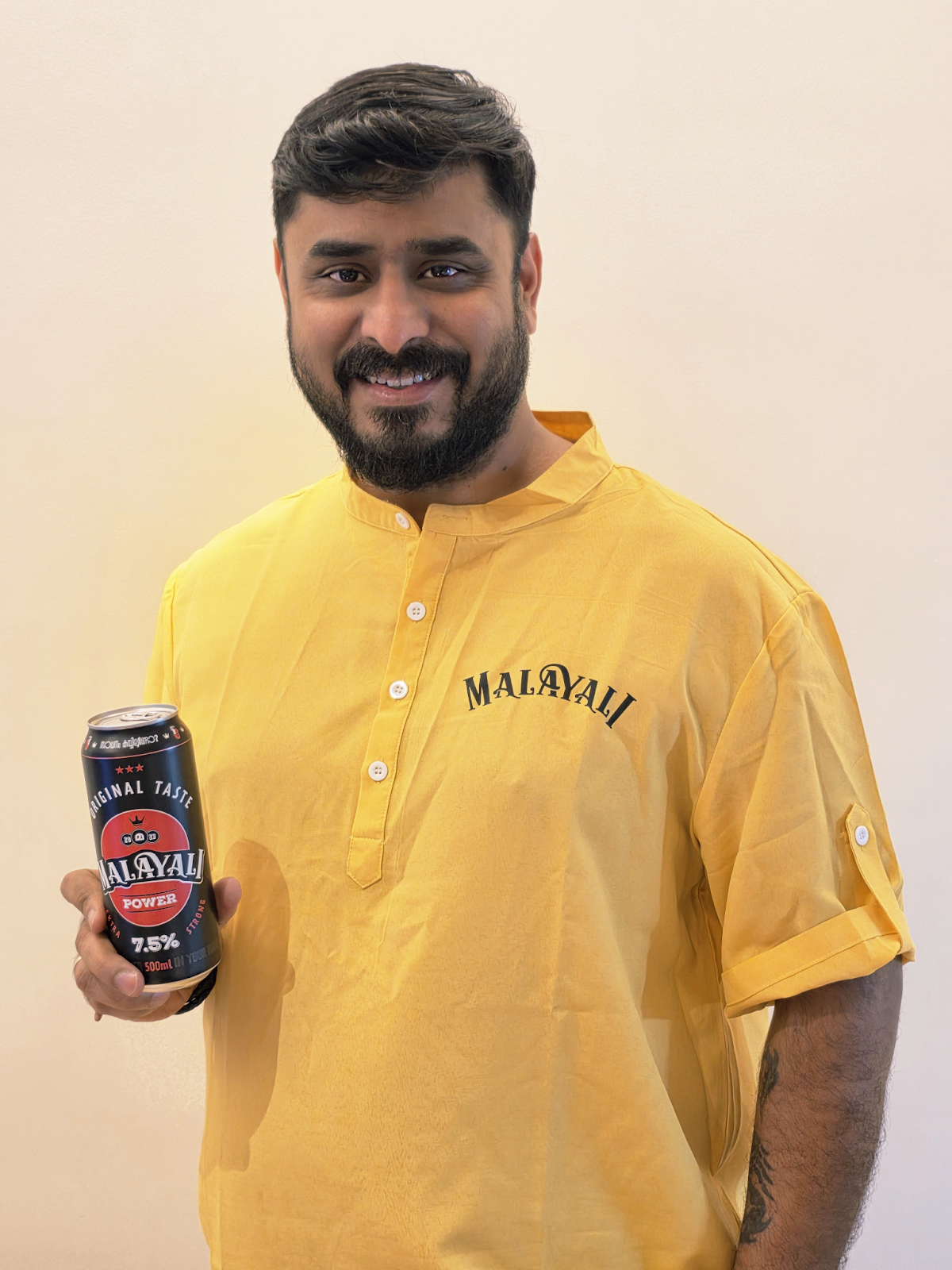


Chandramohan “Chandu” Nallur has never tasted alcohol and has no plans to start. Yet the Kerala-born entrepreneur has steered Malayali Beer from a stranded shipment of rice flakes in 2022 to shelves across 25 countries, earning Gold and Bronze medals at the 2025 World Beer Awards along the way. Operating from Warsaw under Hexagon Spirits International, Nallur and co-founder Sargheve Sukumaran have moved over a million cans in under three years. The company has posted roughly 1.3 million euros in yearly revenue with 600 percent growth. The pair now have their sights locked on North America, Africa, and China.
When A Crisis Became A Recipe
Four days before Russia invaded Ukraine in February 2022, a five-ton shipment of Indian rice flakes landed at a European port. The buyer, rattled by crashing exchange rates, pulled out of the deal. Nallur, then serving as Business Relationship Director at the Indo-Polish Chamber of Commerce, found himself staring at a costly pile of grain with no obvious market. Rather than write off the loss, he and his team explored how the raw material might be repurposed.
He punched an odd question into Google. “What can I do with rice flakes?” The search engine delivered a single, startling answer. Beer. Nallur grabbed his phone, called Sukumaran, a product strategist, design graduate, and branding mind based in Warsaw, and pitched the wildest idea of his career. Sukumaran said yes.
Neither man had brewed anything before. They toured breweries across Warsaw, partnered with European brewers, tried Polish hops, and stumbled through batches that people called too bitter or too flat. They kept tweaking. The shift arrived when they swapped Polish hops for Czech varieties and Bavarian malt, then pulled back the grain ratio until the rice flakes softened the bitterness with a gentle sweetness. The result was a hybrid lager that drinkers started calling “probably the smoothest lager in the world.” Repeat orders poured in. Within two months of the launch, the brand moved 50,000 bottles across Poland.
“I had to figure a way out,” Nallur recalls. “Initially, I thought of turning the flakes into animal feed, but that would have taken nine months for approval. Sending them back meant a total loss. So I took a leap of faith into an industry I never imagined I would enter.”
The name itself carries weight. During Operation Ganga, India’s evacuation mission from war-torn Ukraine, the founders noticed that a striking number of volunteers on the ground were Malayalis. They decided the beer should carry that same spirit of showing up wherever you are needed. The label, crafted by Sukumaran and a Kochi-based creative firm, draws from Kathakali headgear and a pair of Ray-Ban sunglasses made famous by Malayalam cinema icon Mohanlal. Every detail was meant to feel unmistakably Indian yet universally inviting.
“Malayali is more than a place,” Nallur has said. “It represents a way of moving through the world. People move, tastes travel, and products have to make sense in more than one context.”
A Sober Mind Behind The Bar
Most beer founders talk about taste memories and late-night moments over a pint. Nallur talks about spreadsheets and supply chains. He approaches the alcohol trade like an analyst, studying what happens after the final sip rather than during it. Does the beer sit well with spicy food? Does it leave the drinker bloated or relaxed? Can someone who avoids alcohol still join in the ritual?
“Being a teetotaler keeps my head cool,” he says. “I do not romanticize the product. I study what it does to people’s bodies and situations.”
That distance became a genuine competitive edge. Without relying on personal taste, Nallur depends on consumer feedback, market data, and distribution insights. Malayali’s hallmark claim is the “zero burp” lager, a beer so smooth that it rests quietly beside a plate of curry or a bowl of pasta without the heaviness drinkers have come to accept from mainstream brands. Word spread through Indian restaurants in Poland first, then reached Italian trattorias, Mexican cantinas, and Polish lounges. Nallur had shaped a product that solved a problem most people never thought to name.
Those questions guided the entire product range. Malayali Lager, the flagship, targets European palates with a light, crisp profile that pairs cleanly with meals. Malayali Power caters to stronger preferences across the Middle East and Southeast Asia. Malayali Habibi, a non-alcoholic variant, opens the brand to consumers who want the social feel of beer without the buzz. The company has grown into a broader lineup that speaks to shifting tastes globally, with the non-alcoholic segment gaining strong traction where alcohol faces limits or moderation trends take hold.
“I am building a beverage empire without drinking a drop,” Nallur says. “Maybe that distance helps. Instead of chasing the next buzz, I am thinking about how people actually feel after their beer, especially with food.”
Sukumaran’s presence balances the analytical rigor with a designer’s eye. He considers how Malayali feels on the shelf and on the table, from the look of the label to the feeling someone gets when spotting the word “Malayali” in a bar far from Kerala. “We are selling the confidence that a beer from a Malayali founder can stand next to any global brand on quality,” Sukumaran notes.
Pouring Across Borders
Malayali’s growth arc reads like fiction. The brand debuted at the 2025 World Beer Awards in Norwich, England, and walked away with Gold for its lager and Bronze for its non-alcoholic Czech-style variant, beating out breweries with century-long head starts. The win capped a three-year sprint that has landed the beer in duty-free shops at Cochin International Airport, Muscat International Airport, and a growing list of retailers from London to Singapore.
Hexagon Spirits International operates with a spread-out model, working with producers and partners across regions rather than owning large central facilities. Nallur and Sukumaran mapped their distribution playbook early. They target the second-largest FMCG distributor in each new market rather than the biggest. The logic is simple. The number-two player carries more hunger and gives a young brand more attention. Through those partners, Malayali first entered Indian restaurants and then expanded into mainstream spots once word-of-mouth did its work.
Revenue has multiplied six times over, and the team recently secured nine crore rupees from a Middle Eastern angel investor to fuel the next wave. North American shelves are the immediate target, followed by Africa and China. Competition remains fierce. Established brands such as Kingfisher and Cobra dominate the Indian-origin beer story internationally, backed by decades of distribution networks and marketing muscle. Malayali Beer stands apart through specificity. Its hybrid brewing approach challenges old assumptions about purity and origin in beer-making.
“You do not have to be in Amsterdam or Munich to define what modern beer means,” Nallur says. “You can be from Kochi, build in Warsaw, and pour for the world.”
A vodka brand called Yakshi is waiting in the pipeline, signaling that Nallur’s aims reach well past beer. From a logistics headache on the Baltic Sea to award-winning cans on five continents, the teetotaler from Palakkad has shown that you do not need to drink your product to grasp exactly what the world wants from it. What began as a logistical accident now reads like a manifesto in liquid form, a belief that sobriety and strategy can brew something more lasting than a trend.“Every market has constraints,” he says. “Our business exists because we learned to work within them.”