


The polymath behind many innovations in supercomputing, AI, healthcare, longevity science, and technology is building the Herschel-Balki Observatory: an AI-driven public observatory in the largest Gold Tier dark sky park in Europe, named for the father-and-son astronomers who founded modern stellar astronomy. With a 1960s space-race museum and Rosewood-inspired stargazing hale attached. He met us at the Big Island resort that came back from the dead.
The Shipwreck Bar at Kona Village, A Rosewood Resort, sits exactly where it stood in 1965, when Johnno and Helen Jackson dragged their sunken schooner onto the sand at Kahuwai Bay and turned its skeleton into a watering hole. The 2011 tsunami took it apart along with everything else on this 81-acre stretch of lava-baked Big Island shoreline. When Rosewood reopened the property in July 2023, twelve years and a complete archaeological inventory later, the bar was rebuilt from the original scraps, returned to the same patch of beach, oriented to frame the same sunset.
Dr. Eric Balki is studying it the way someone might study a thesis statement.
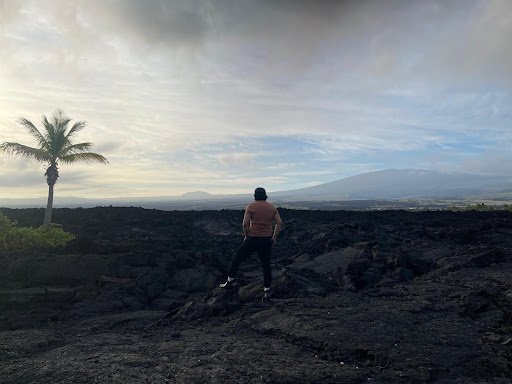
“This place was completely destroyed,” he says, gesturing across the hale-dotted grounds, where 150 thatched-roof bungalows sit on the footprints of the originals. “The tsunami caused by the earthquake in Japan landed here. The whole resort was destroyed. But the regeneration happened with care. They went back to the lineal descendants, formed a cultural advisory committee before they even started, rebuilt on the original foundations, went off-grid, built a solar field, and had native artists in every room. The mistake would have been to start over. Instead, they came back to the same place, but went deeper into its history and culture.”
He pauses. “I think there’s a lesson in that for what we are doing to bring our observatory to life in the North of England.”
The Herschel-Balki Observatory (named for William Herschel, who discovered Uranus in 1781 from his garden in Bath and effectively founded modern stellar astronomy, and his son John, who extended the Herschel catalogue to the southern hemisphere from the Cape of Good Hope) is the kind of project that sounds, when described aloud, like several projects. Dr. Balki is the pioneer behind TriPyramid Ventures, a London-headquartered group spanning technology, healthcare, and resort development, and holds an honorary research fellowship at Lancaster University’s Faculty of Health and Medicine. He wants the Herschel-Balki to be one of the most technically advanced AI-enabled public observatories in Europe, accessible to schools, university researchers, working astronomers, and amateurs on equal terms.
A 1960s space-race museum will accompany it, with original technical drawings from the programmes that became Apollo, including work by Wernher von Braun and the illustrator Fred Freeman. And yes, he wants cabins inspired by Rosewood hales, a short walk from the observatory building, so that visitors can spend the night under the sky.
To understand why he flew 7,400 miles to the middle of the Pacific to think about this, you have to understand the vision.
Why Mauna Kea matters
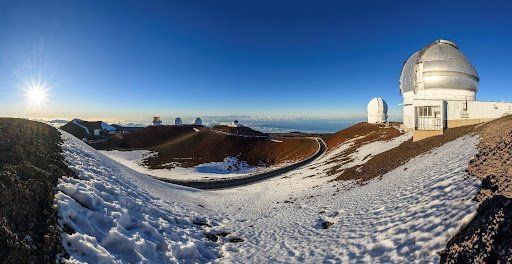
The Mauna Kea Observatories sit at 13,800 feet on the summit of a dormant volcano whose air is dry, whose seas are thermally stable, and whose sky is dark in a way that almost nowhere else on Earth still manages. Thirteen telescopes from eleven countries operate there, and their combined light-gathering power is roughly fifteen times that of the Palomar telescope in California and sixty times that of the Hubble Space Telescope.
Balki spent his Big Island week ascending and descending. He visited the Keck Observatory complex, where two ten-metre primary mirrors made of thirty-six hexagonal segments each work in concert as a single reflective surface, the segments held in place by 168 computer-controlled actuators that adjust their position several times a second. He looked at adaptive optics, the technology Keck pioneered for large telescopes in 2004, which fires a laser into the upper atmosphere to create an artificial guide star, measures the atmospheric distortion against it, and then deforms a secondary mirror in real time to cancel the blur. The result, on a good night, is sharper imaging than the Hubble Space Telescope ever produced.
He spent time researching the University of Hawaiʻi’s 2.2-metre telescope, where the Institute for Astronomy has just brought online Robo-AO-2, a robotic laser adaptive optics system that observes hundreds of objects per night with minimal human oversight. It is a glimpse of what fully autonomous, AI-orchestrated observation will look like. He has spoken with people at the Subaru Telescope, the Canada-France-Hawaii Telescope, and the United Kingdom Infrared Telescope, the last of which has carried Britain’s name on a mountain in Hawaii for nearly half a century.

“What I went there for,” Balki says, “was to understand what ‘world class’ actually means in 2026. It’s not the size of the mirror anymore. The Extremely Large Telescope being built in Chile will have a 39-metre primary, and that’s the size race. We won’t be able to win the size race at the Herschel-Balki, and we shouldn’t try. We need to use the latest technologies and be smarter. What I went to learn was the architecture: the integration. Adaptive optics, robotic scheduling, AI-driven data pipelines, and the public-access ethos that makes the whole thing matter beyond a paper count.”
Siting the Herschel-Balki
The site is being constructed in the 580-square-mile Northumberland International Dark Sky Park, designated Gold Tier by the International Dark-Sky Association in 2013: the first such designation in England, the largest contiguous Gold Tier protected sky in Europe, and on a level with Death Valley and Big Bend in the United States. The Campaign to Protect Rural England’s Night Blight survey rates the skies above Kielder as the darkest in the country.
The existing Kielder Observatory, opened in 2008 and run as a charity, hosts more than 700 events a year for over 20,000 national and international visitors. It is the model Balki cites most often, and the thing he wants the Herschel-Balki to sit alongside rather than compete with.
“Kielder is beloved and rightly so,” he says. “What it has shown is that there is a public hunger for this in the region that is enormous and largely unmet. People drive for hours, in February, to lie on a deck and look up. Schools come. Families come. The waiting list for the main evening events is real, and access is usually quite difficult. The question I asked myself was: if you were going to build the next-generation companion to Kielder, not in competition, in partnership, what would the technology stack look like, what would the public experience look like, and what would the science actually do?”
The technical specification, which Dr Balki has been refining with his own research and teams of consulting astronomers (Balki declines to name them on the record), points toward a primary instrument for the Herschel-Balki in the 1.5–2.5 metre class with a deformable secondary mirror for adaptive optics correction at the source, a configuration the University of Hawaiʻi’s Mark Chun is currently testing at the 2.2-metre, and one of the things Balki was specifically there to check out. The proposed AI layer would handle target acquisition, observation scheduling, and a first-pass anomaly detection pipeline against the night’s data, what Balki describes as “the difference between recording the sky and watching it.”
“Public access is not the same as public outreach,” he says, with the look of a man who has thought about this for a long time. “Outreach is a talk and a viewing slot. Access is real-time on the instrument. We want researchers at universities, sixth-form astronomy classes, and a working astronomer from anywhere in Europe to have a credible queue time. AI scheduling makes that possible because the telescope can be working on a deep-sky survey one minute and pivoting to a transient candidate the next, with the human in the loop only where the human matters.”
What might that produce, scientifically? Balki is careful here, in the way an academic has to be when predicting the results of an experiment never done before.
“The fields where a 2-metre instrument with sharp adaptive optics and a strong AI back-end can make a real contribution are exoplanet transit photometry, time-domain astronomy on the variability of active galactic nuclei, and the rapid follow-up of transient alerts from the Vera Rubin Observatory’s survey. The big mountains will discover things; we want to be in the network that confirms them and characterises them. That’s a real, useful place to be.”
But the answer to the size-race problem, Balki argues, is not to give up on the deep-sky science. It is to redefine what aperture means in 2026.
“You don’t need a 30-metre mirror to get 30-metre resolving power,” he says. “You need 30 metres of baseline. That has been understood in radio astronomy for fifty years; the Very Long Baseline Array is the obvious example. In the optical and infrared, it is harder, but it is being done. The Keck Interferometer linked their two 10-metre telescopes from 2001. The CHARA Array on Mount Wilson networks six 1-metre telescopes across a 330-metre baseline and routinely produces angular resolution finer than the JWST for certain measurements. None of CHARA’s individual mirrors is large. The array is large.“
The Herschel-Balki scheme, as Balki describes it, is built around exactly this principle. The primary instrument in the dome would be the headline asset, but a planned constellation of 30 to 40 smaller, commercially available, AI-coordinated telescopes will be distributed across the wider Lake Biminy site at distances measured in tens of metres on the shorter baselines and hundreds of metres on the longest. The network would function as a synthetic aperture vastly larger than any single mirror. The AI layer is what makes this affordable for a project at this scale: real-time atmospheric phase compensation, fringe tracking, data fusion, and the heavy computational lift of inverse-problem image reconstruction are exactly the workloads modern machine-learning hardware handles well.
“What we are buying with AI,” Balki says, “is the ability to compete internationally on capability without competing on glass. A 2-metre primary plus a coordinated array, run through a modern ML data-fusion pipeline, is a fundamentally different proposition from a 2-metre primary on its own. It is also, candidly, a fundamentally different price point from a single 8-metre telescope. We are talking about an order-of-magnitude difference in capital cost for science that, in some specific domains (high-resolution imaging of stellar surfaces, close binary systems, the inner regions of active galactic nuclei), can hold its own against the largest single-aperture instruments in the world. That is the bet.”
It is, he concedes, an ambitious bet. Optical interferometry is harder than radio interferometry by orders of magnitude: wavelengths are shorter, atmospheric coherence times are measured in milliseconds, and engineering tolerances are unforgiving. The contribution AI is making to the field is recent enough that some of the techniques Balki is counting on were not in routine use five years ago. But the trajectory is clear, and the cost curve is moving in his favour faster than any single-mirror project’s ever could.
The museum and the hale
The museum is the part of the proposal that surprises people. Balki’s plan calls for a permanent exhibition of original 1960s space-race artefacts: technical drawings by Wernher von Braun himself, Fred Freeman’s depictions of space stations and lunar orbiters, slide-rule calculations from the trajectory teams, and hardware concepts that fed into Apollo. Balki has been actively involved in collecting them.
“My generation in the UK didn’t grow up with this material,” he says. “We grew up with the moon landing in textbooks. The drawings have historically been in archives, in private hands, and in Houston basements, and we are working hard to acquire them and bring them into the public domain for everyone to enjoy and access, and, most of all, to dream big. If we can put a few of them on the wall of a building that a school trip is walking out of after leaving our planetarium dome, we are doing something that text cannot do. We can inspire a whole new generation in space technology and science.”
And then there are the hale, a concept Balki clearly enjoys. He has been turning the Kona Village playbook over in his head.
“They are off-grid here,” he says. “They went solar. They sourced locally. They worked with the descendants of the original community. The hale itself is a culturally specific Hawaiian dwelling and we are not going to copy that. What we are going to take is the principle, and the word, with respect, and apply it to a vernacular that belongs to our own landscape: the equivalent of hale in Northumberland is “the cruck”, a framed timber house that used to dot the English countryside from the 13th to the 15th centuries. It will form visitor accommodation that is designed for the place, that doesn’t fight the dark with light, that respects the landscape it sits in.“
The headwinds, candidly
Building a substantial observatory inside a National Park is the kind of proposition that has stopped many comparable projects before they began. Northumberland National Park Authority’s planning regime is one of the more careful in the United Kingdom, the politics of new development on protected land are exacting, and Balki has worked on this concept through planning stages for over five years. That this application cleared it is an uncelebrated achievement that speaks to his tenacity.
Planning permission for the Herschel-Balki Observatory has been granted. It was, in Balki’s understated formulation, “hard-won.” The full case ran to several thousand pages across heritage, ecology, dark-sky impact, traffic, and visitor-management volumes, took the better part of four years to assemble, and required patience with detail that Dr Balki carefully chipped away at. The financial model for a public-access observatory of this ambition is its own continuing challenge: the science requires capital expenditure that does not pay back on a hospitality timetable, and the hospitality requires governance that does not interfere with the science. Balki knows what was involved. He has spent his career solving complex macro problems.
Balki is in discussions to secure part of the funding from a Canada-based telescope-instrumentation firm (Balki declines to name the partner on the record at this stage) whose engineering portfolio, he says, “lines up extremely well with the array architecture we are designing.” Canada has a substantial astronomy-instrumentation industry that punches well above its weight: NRC-Herzberg in Victoria, ABB’s optical systems group that supplied components to JWST and the Thirty Meter Telescope, the long Canadian involvement in the Canada-France-Hawaii Telescope on Mauna Kea itself. Interest from a commercial partner of that calibre in a not-yet-built British public observatory is not a small signal.
“It will not solve the capital problem,” Balki says, carefully. “It validates the architecture and the concept. The fact that people who understand this technology far more than I do have looked at our specification and chosen to support us tells me the engineering case stacks up.”
“You ask me what could come in the way of this,” he says. We have walked, by this point, from the bar to the hale he has been staying in, one of the legacy bungalows on the southern edge of the property, rebuilt on the foundation laid down in 1965, the lanai opening west over Kahuwai Bay. The afternoon has gone gold, the kind of Big Island afternoon where the air seems to thicken and the surf goes quieter. “Capital, construction, partnership, talent, regulatory hurdles, and the absence of government support for an initiative like this. Any one of them could. Several have stopped projects like this before. What I would say is that the UK has world-class science talent, the largest Gold Tier dark sky in Europe, and a public that, as evidenced by Kielder, is hungry for this. The ingredients are here. I just need to assemble them.”
He gestures, half-smiling, at the view of the resort from the hale: the lava field beyond, the rebuilt foundation under our feet.
“Just like this was possible, it allows me to be inspired by the future.”
Dr. Eric Balki is a tech pioneer, CEO and Chairman of TriPyramid Ventures, and an Honorary Research Fellow at Lancaster University’s Faculty of Health and Medicine.