
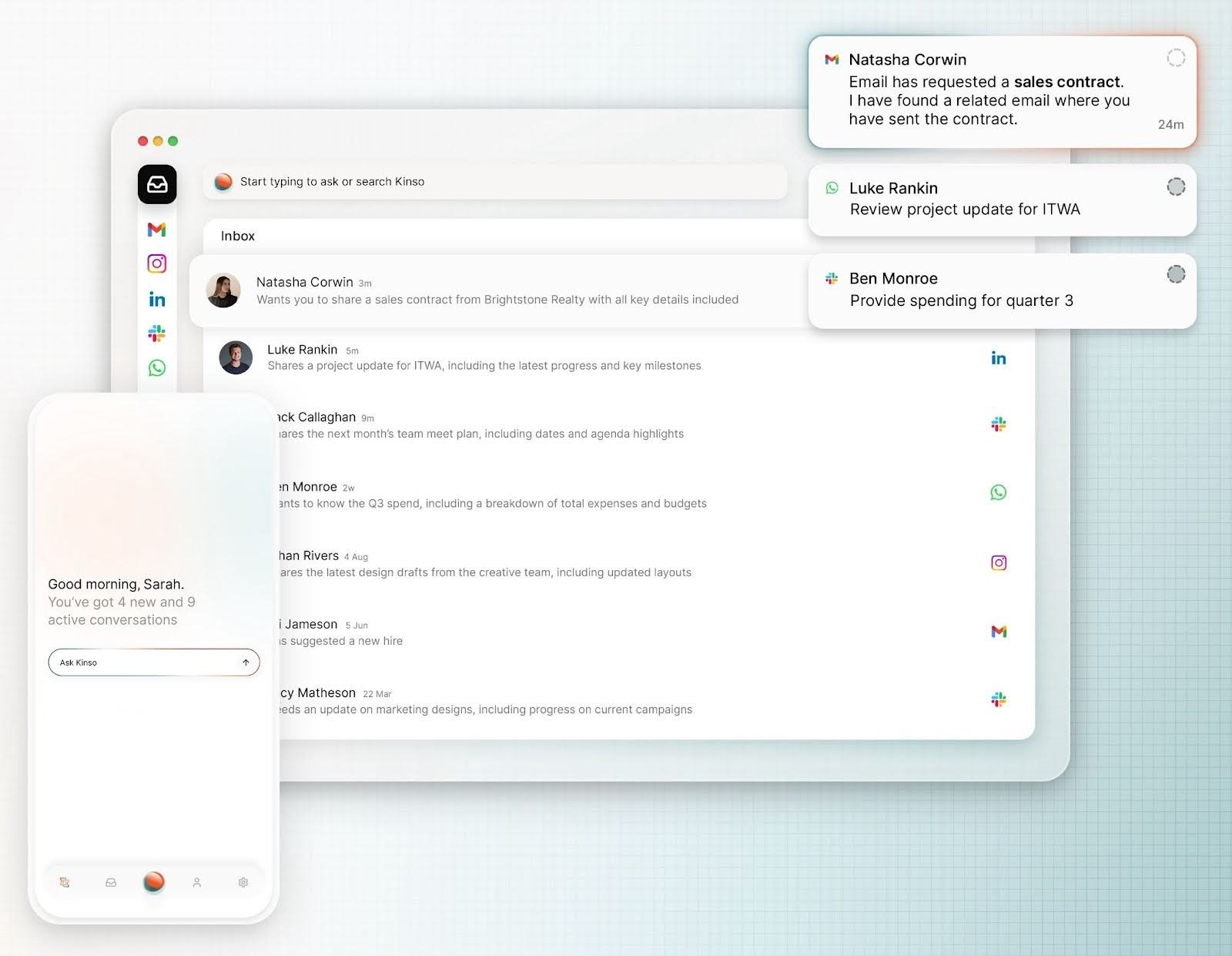


On a typical weekday morning, a founder’s attention is split before the first coffee is finished. A venture investor drops a casual line about “looking at AI again” in a LinkedIn DM. A candidate mentions being “open to a move next quarter” in Slack. A customer hints at expansion plans in an email, then reiterates them in a quick WhatsApp message. Each of these is potentially meaningful. None of them lives in the same place. The who, what, when, where, why, and how of modern work now unfold across channels that rarely talk to one another. Kinso, a young AI company building a “one inbox, every conversation” workspace, is betting that the real opportunity is not just to collect these fragments, but to connect them into a living context graph that can show operators where to act next.
That bet places Kinso at the center of a broader shift in the productivity and communication industry. Its position is more ambitious: treat emails, DMs, chats, calendars, and contacts as one interconnected system, then use AI to turn that system into an “opportunity stack” rather than a chronological log. In a capital-efficient, relationship-led environment, the company is asking a simple question with far-reaching implications: if every conversation is a data point, what would it mean to actually see how they fit together?
From Unified Inbox To Context Graph
The most visible development in Kinso’s space is the race to build a universal inbox that can handle the modern stack of tools: Slack, WhatsApp, LinkedIn, TikTok, email, and beyond. Years ago, “inbox” was effectively shorthand for email; today, it is an abstraction that covers dozens of interfaces and notification systems. Many products now promise to unify or centralize messages. Kinso’s own foundation is similar at first glance: a channel‑agnostic engine that integrates major communication platforms and surfaces every thread in a single dashboard.
In practice, this graph-based view alters the inbox’s core function. Rather than sorting by recency or unread status, Kinso produces what it calls an “opportunity stack”: a prioritized hierarchy of communications based on their potential business impact—fundraising, hiring, revenue, or strategic relationships—rather than on who shouted loudest or latest. A terse, unassuming message about expansion plans from a key customer may rise above a dozen “urgent” internal updates because the model has learned that expansion signals map directly to that user’s growth objectives.
The graph also allows Kinso to treat long-running threads as a single topic, even when they span multiple platforms. A discussion that starts in email, continues in DMs, and ends in a group chat is tracked as one coherent conversation rather than three unrelated fragments. For operators who have grown used to spending fifteen minutes hunting through apps for a missing detail, this topic-level view is less about elegance and more about not missing the detail that changes a decision.
A Second Brain For High-Stakes Operators
Kinso’s mission—giving high-performing founders and operators “instant, actionable clarity on every conversation so they can move faster, deepen relationships, and spot opportunities first”—shows up in how people are meant to interact with this context graph day to day. At its most basic, the system is a universal inbox: it brings every email, message, and contact into one smart workspace and uses AI to understand the user’s goals. But above that base layer, it behaves more like a second brain tuned to high-stakes communication.
Universal search is an obvious entry point. Kinso lets users retrieve information in plain English—“Show me what Sarah said about Series A last month” is treated as a reasonable query, not a vague wish. Because the underlying graph links messages across email, Slack, WhatsApp, LinkedIn, Instagram, and more, the answer can pull from multiple channels and present a cohesive summary rather than a scatter of results.
Pre‑meeting preparation sits on the same foundation. Before a call, Kinso can generate “flash cards” that surface personal details, priorities, and open loops from past interactions across platforms. In effect, the system is saying: here is who you are about to talk to, here is what you have been circling around together, here is what you have not yet closed.
The company also leans into what it calls “next‑step intelligence.” When the graph detects a request, it does not simply tag it. Instead, it scans the user’s network, suggests the right connector, and pre‑writes an introduction or follow‑up designed to keep momentum. The idea is that attention should not stop at recognition; it should naturally flow into action.
From Messages To An Opportunity And Risk Engine
Where Kinso’s context graph becomes most distinct is in how it recasts communication as a stream of opportunities and risks rather than a neutral record. Internally and in external coverage, this is described as a “contextual opportunity engine”: a live mind‑map of themes across messages that highlights where a leader’s attention is likely to change outcomes.
On the opportunity side, the engine might elevate a cluster of weak signals into a clear prompt. Three founders mention needing similar go‑to‑market help; several investors in adjacent spaces show interest in a new category; a set of small customer comments quietly signal demand in a new region. By linking discussions from email, chat, calendars, and contacts, Kinso turns scattered information into what one observer called “a connected, opportunity‑focused narrative.” The context graph is what makes that narrative possible: it encodes who is talking to whom, about what, and with what implied intent.
On the risk side, the graph can surface patterns that traditional inboxes would never flag. A customer’s replies begin to slow; a previously engaged investor becomes less responsive; and a hiring process shows signs of stalling across multiple touchpoints. Rather than waiting for these issues to show up as lost deals or churn, Kinso highlights them as relationship risks. Leaders step into meetings with that risk map in mind, better prepared to address not only what people are explicitly saying but also what their behavior across channels suggests.
All of this depends on trust in both senses: prioritization and data handling. Kinso’s model explicitly diverges from generic email “importance” filters that rely on sender reputation or sheer frequency. It scores communications against concrete business activities: fundraising, strategic hiring, and revenue‑generating opportunities. At the same time, the company emphasizes a privacy‑first architecture with on‑device encryption and granular permissioning, recognizing that high‑stakes deal flow, personnel decisions, and confidential conversations flow through the system.
This focus on attention as a strategic asset also shapes Kinso’s release cadence. The product is built with a founder‑led, weekly public ship rhythm, informed by thousands of wait‑list users who “live the problem” of fragmented communication. Their workflows feed back into the evolution of the context graph, ensuring that new features are tested against real, messy streams of communication rather than idealized examples.
A Closing Observation On Context As Leverage
Kinso’s context graph arrives at a moment when “productivity” tools are under reevaluation. For years, the focus was on speed. But as message volume continues to compound and channels proliferate, speed alone no longer feels like leverage. What matters is knowing which five conversations, out of hundreds, are actually decisive.
That is the gap Kinso is trying to fill. Its universal inbox is less an aesthetic consolidation and more a claim about what will define effectiveness for high‑performing operators over the next decade: not the ability to process more messages, but the ability to see their underlying structure. In Kinso’s view, the graph is where that structure lives.
The remark that flows from this is understated but sharp: in a world where time is finite, and communication is infinite, the organizations that win will be the ones that can see the context around their conversations clearly enough to act before others do. Kinso’s distinct role in its industry is to make that kind of clarity feel less like a luxury and more like a baseline—a warm but unblinking companion that quietly turns the chaos of everyday messages into a usable map of what might be possible next.