
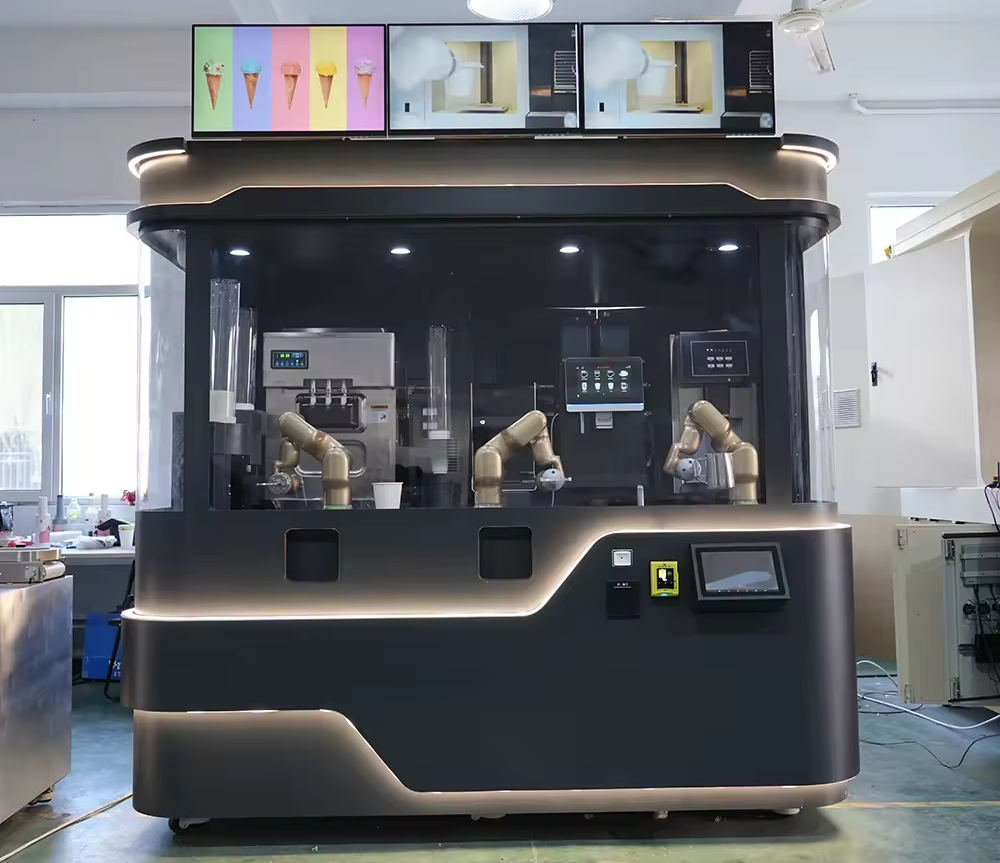


Robot cafés are no longer limited to temporary showcases or technology fairs. Over the past three years, automated food-and-beverage kiosks have quietly appeared in airports, university campuses, hospitals, and tourist destinations, driven by labor shortages and pressure to control operating costs. According to the International Federation of Robotics, service robots deployed in hospitality and retail continue to grow annually, even as overall consumer spending fluctuates. The core question facing operators now is not whether the machines work, but whether the economics do.
Early pilots revealed a mixed picture. While automation can reduce dependence on hourly staff, it introduces new fixed costs: equipment, software maintenance, consumables logistics, and daily oversight. A robot café’s success increasingly resembles that of any small retail operation, shaped by product mix, foot traffic, and uptime rather than novelty alone.
From Single-Serve Kiosks To Broader Menus
Initial robot cafés often focused on speed and spectacle, mostly preparing coffee or tea. Operators soon found that limiting menus constrained revenue, particularly when customers arrived in groups with different purchasing preferences. Expanding the range of products has been one way to stabilize daily sales without increasing staffing costs.
Platforms such as CafeXbot have tested broader menus that include hot and cold beverages alongside desserts and packaged snacks. “If one customer wants coffee and another wants ice cream or a snack, the system has to accommodate both,” said one of the company’s cofounders. The goal, operators say, is less about constant throughput than capturing multiple purchases during a single visit.
This strategy mirrors traditional food retail logic. A robot café that only replaces a single drink order must generate very high volume to break even. A kiosk that captures family or group spending can lift average transaction value without extending service time.
Location Density And Round-The-Clock Demand
As with conventional cafés, location selection remains decisive. Shopping malls offer visibility but also heavy competition. Operators report more consistent performance when robot cafés are placed in high-footfall environments where convenience outweighs brand loyalty, such as train stations, hospitals, and university campuses.
Tourist destinations have also emerged as testing grounds. Visitors tend to spend more per transaction and are more willing to try unfamiliar formats. At the same time, running multiple kiosks within a limited geographic area has proven important for controlling costs. Daily cleaning and restocking typically take one to two hours per unit, making isolated installations harder to justify.
“The math works differently once you manage several kiosks in one zone,” said a CafeXbot cofounder. “You spread supervision and logistics across higher volume, rather than treating each unit like a standalone experiment.” Economies of scale, not just automation, appear central to any robot café strategy.
Reliability, Data, And Long-Term Cost Balance
Automation also shifts risk toward technology reliability. Downtime can erase labor savings quickly, particularly in settings such as airports where customers expect speed. Many operators now prioritize industrial-grade components and proven software over rapid expansion. Remote monitoring tools that track sales, inventory levels, and technical issues allow operators to intervene before small problems disrupt service.
Another advantage is in operating hours. Robot cafés can function overnight without additional staffing costs, extending revenue potential in 24-hour locations. Over time, labor savings, predictable output, and data-driven inventory planning may improve margins, provided maintenance and replacement costs remain under control.
Industry analysts note that the global market for service robots in hospitality is still early-stage. Profitability varies widely, and not all kiosks succeed. What is changing is the framing: robot cafés are being judged less as curiosities and more as small infrastructure investments. Their future depends on fundamentals familiar to any operator willing to test whether automation, used selectively, can support a sustainable business rather than a temporary attraction.