


Inside one of Manaus’s busiest emergency departments, something has quietly changed: patients are getting to a doctor faster, and the physicians treating them are working with an AI system they actually trust.
Samel Hospital, the dominant private healthcare network in Brazil’s Northern Region, has received a 2026 Global Recognition Award for the development and deployment of SAMIA (Samel Artificial Intelligence), a platform so profoundly embedded in the hospital’s clinical workflows that it has cut patient wait times by 33% and achieved a 99.85% rate of AI-generated documentation that requires zero physician edits. In a sector where AI pilots routinely outpace AI results, those numbers stand out.
The hospital isn’t new to this. Forty-four years of operating in Manaus have shaped a health system that now covers eight units, including three hospitals, five medical centers, and two more facilities under construction, employing over 1,000 staff and more than 900 physicians delivering round-the-clock care to a covered population exceeding 150,000 lives.
The Architecture Behind The Ambition
What makes Samel’s AI story credible, more than the technology itself, is the structure that supports it. The hospital operates as a vertically integrated system, with governance, clinical quality, and financial planning unified under one roof, so technology investments don’t get lost amid competing budget priorities. Most healthcare networks can’t say the same.
That integration also means SAMIA wasn’t built as an add-on product. It was engineered to work inside Samel’s existing electronic medical record system, handling digital pre-triage, structured patient history generation, automated clinical summaries, ICD-based diagnostic support, real-time drug interaction alerts, and discharge guidance, all in line with evidence-based clinical protocols. Specialist AI agents assist physicians in real time, surfacing relevant medical literature during moments that demand fast, accurate decisions.
Certification from Brazil’s National Accreditation Organization adds an independent layer of verification to the quality standards built into the hospital’s daily operations. This credential carries weight in a market where healthcare quality varies considerably across regions.
The Numbers That Make The Case
Healthcare AI is full of impressive-sounding claims. Samel backs its claims with data. Diagnostic support using ICD logic achieves close to 90% accuracy, a meaningful improvement in consistency for Emergency Department physicians who make consequential decisions under pressure. Wait times for medical evaluation fell by a third following the rollout of SAMIA in the ED. That 99.85% edit-free anamnesis rate isn’t just a quality metric; it’s a signal that clinical staff are using the system with confidence rather than treating it as an obstacle to work around.
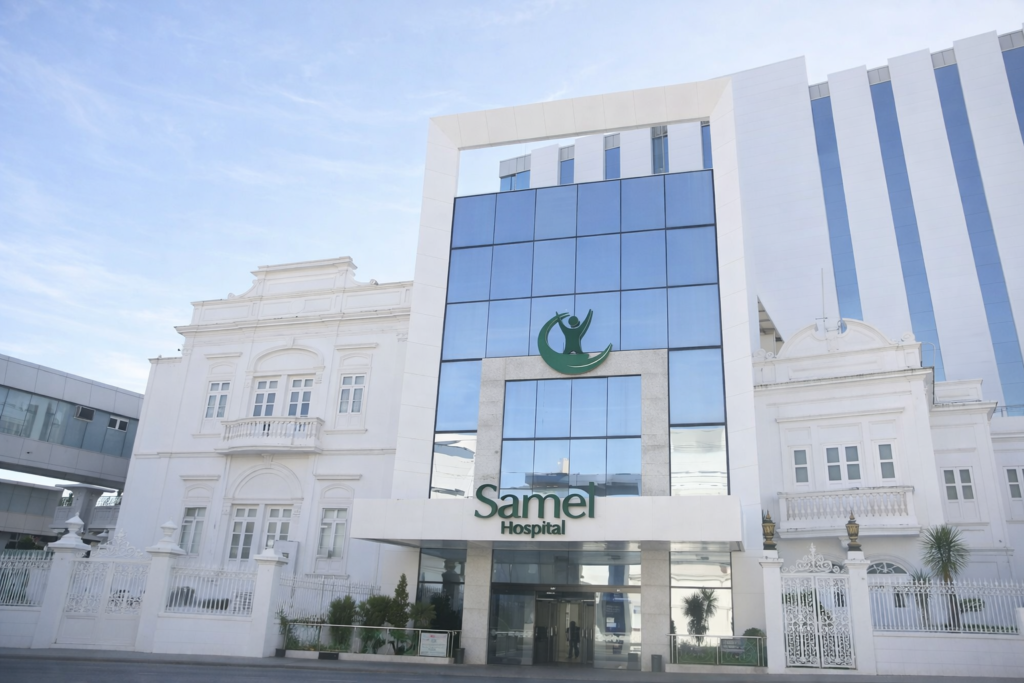
Photo Courtesy of Samel Hospital
Global Recognition Awards assessed Samel’s submission using the Rasch model, a linear measurement framework that enables precise comparisons across applicants in the same category. Evaluated across seven innovation dimensions, including novelty, market impact, technological advancement, adoption rate, and disruption of existing paradigms, the hospital earned the top rating of 5 in every dimension.
“What Samel Hospital has accomplished with SAMIA is not a technology demonstration; it is a functioning clinical system that is making patients safer and reducing the time they wait for care,” said Alex Sterling, a spokesperson for Global Recognition Awards. “That combination of scale, accuracy, and measurable clinical impact is exactly what a 2026 Global Recognition Award for Innovation is designed to recognize.”
A Blueprint Others Will Watch
The broader significance of Samel’s work isn’t lost on observers of Latin American healthcare. Emerging markets have historically struggled to move AI adoption beyond controlled trials, where infrastructure gaps, data standardization challenges, and capital constraints are real barriers. Samel has worked through all three, deploying a system that operates at full scale across a large, geographically concentrated patient population, with outcomes tracked and reported.
The hospital’s investment in clinical data infrastructure has strengthened the platform’s long-term viability, laying a foundation that can expand as medical knowledge and AI capabilities continue to develop. With two additional hospital units under construction and a growing outpatient network, the system will face further pressure, and, on current evidence, it appears well positioned to meet it.
For private healthcare operators across Latin America and beyond, looking for a replicable model that ties digital investment directly to patient outcomes, Samel Hospital has built something worth studying, not because of what it promises, but because of what it has already delivered.