

High-end fashion has long taught people that important decisions rarely happen in a single step. Garments move from sketch to toile to fitting room before they ever reach a runway or wardrobe, with each stage refining how a piece sits on the body. Tattoos, by contrast, have typically skipped that middle ground.
Clients agreed to a design on paper and trusted that it would translate cleanly onto skin, even though there was no real way to “try it on” first. PRIC’D, the tattoo visualisation and booking platform created by entrepreneur Kay Kiani, aims to change that logic by serving as a kind of digital fitting room for body art.
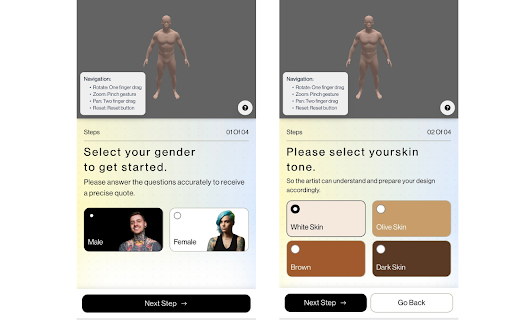
The platform sits at the intersection of technology, beauty, and high fashion. It allows users to upload or select tattoo designs, map them onto a true-to-life 3D model of their own body, and see how size, placement, and composition work from multiple angles before they commit.
That process echoes the way clients step in front of mirrors during a couture fitting to evaluate how a piece falls, where seams hit, and how the garment moves. “Couture never goes straight from sketch to final garment,” Kiani mentions. “We felt tattoos deserved the same level of testing and refinement before anything becomes permanent.”
A Toile for Tattoos
Most people understand that a tattoo is different from a dress or a coat. Ink is permanent, subject to ageing and movement, and positioned on a surface that cannot be returned or exchanged. That permanence has always been part of its appeal and its risk. Even with careful stencilling and a skilled artist, there has been a leap of faith between what clients imagine and what they end up wearing. PRIC’D narrows this gap by inserting an extra step between idea and needle.
The tool generates a 3D tattoo preview of the design on a model adjusted for a user’s approximate proportions and skin tone, providing a more accurate sense of scale and flow than a flat drawing ever could.
Kiani believes that seeing a design wrapped around a forearm, sitting under a collarbone, or running along the ribs makes the decision more concrete. Users can move the artwork slightly, change its size, or switch placements entirely and immediately see the difference. That kind of low-stakes experimentation mirrors the role of a toile in couture, where a mock-up lets designers and clients test ideas before cutting into expensive fabric.
For artists, the system functions as a communication tool. Clients arrive at consultations having already explored proportions and placements in PRIC’D, which means conversations can focus on refinement rather than basic feasibility. Kiani describes this as a shift from guesswork to collaboration.
Kiani mentions, “With PRIC’D, you see how the piece flows with muscle, bone, and movement, so you are not just hoping it will suit you—you know it does.” That confidence tends to produce clearer briefs, more aligned expectations, and, ultimately, better outcomes.
Luxury as Clarity
From design to fit, the conversation now includes transparency around pricing, materials, and process. PRIC’D follows that pattern by building clarity into each stage of the tattoo journey. The platform does not stop at visuals. It uses parameters set by studios and artists to calculate real-time pricing as users adjust size, placement, and sometimes complexity of their chosen designs. Clients who might once have waited days for a rough quote in a crowded inbox instead see a live estimate within the app, well before they request a date.
That change has practical consequences. Studios using PRIC’D report that this combination of visual certainty and upfront pricing filters out speculative enquiries and attracts more serious, ready-to-book clients, with some citing up to an 80% improvement in conversion rates.
Artists step into consultations with a clearer sense of who is sitting in the chair and what they want. Clients, for their part, arrive knowing how their idea looks on their body and how it fits within their budget. The dynamic resembles appointments at a couture salon more than casual walk-ins on a high street.
Kiani sees this as an extension of the standards that high fashion customers already expect. “People buying into high fashion expect to know what they are getting, what it costs, and how it will fit into their lives,” he adds. “PRIC’D brings that same standard to tattoos, so the process feels less like a gamble and more like commissioning a made-to-measure piece.”
That language resonates in an industry where clients increasingly treat large tattoos as long-term investments, comparable in price and emotional weight to a tailored suit, a watch, or a piece of art.
Dressing the Body in Ink
There is also a cultural shift that makes PRIC’D’s fashion-adjacent logic feel timely. Tattoos now appear regularly in runway casting, beauty campaigns, and editorial shoots. They are no longer automatically covered or concealed; they are considered part of a subject’s styling, as integral to the image as a jacket or a ring.
Many clients think about tattoos in the same breath as wardrobes, considering how a design will interact with necklines, cuffs, or jewellery, and how future pieces might connect into a broader composition.
PRIC’D leans into that mindset by treating the body as a canvas that must be styled thoughtfully across time. The 3D view helps users understand not only whether a specific tattoo “fits,” but how it might sit alongside existing ink or leave space for future work. That perspective aligns closely with the way stylists and designers think about building looks across a collection or a season. A single piece needs to stand on its own while also fitting into a larger visual story.
The app, in Kiani’s view, does not replace the artist or the studio experience; it prepares both sides to meet at a point where creative decisions are more informed and less driven by impulse.
The founder shares, “A great tattoo, like great fashion, should feel like it was always meant for you. If we can use technology to get closer to that feeling—no guesswork, no surprises—that is where real luxury begins in body art.”