
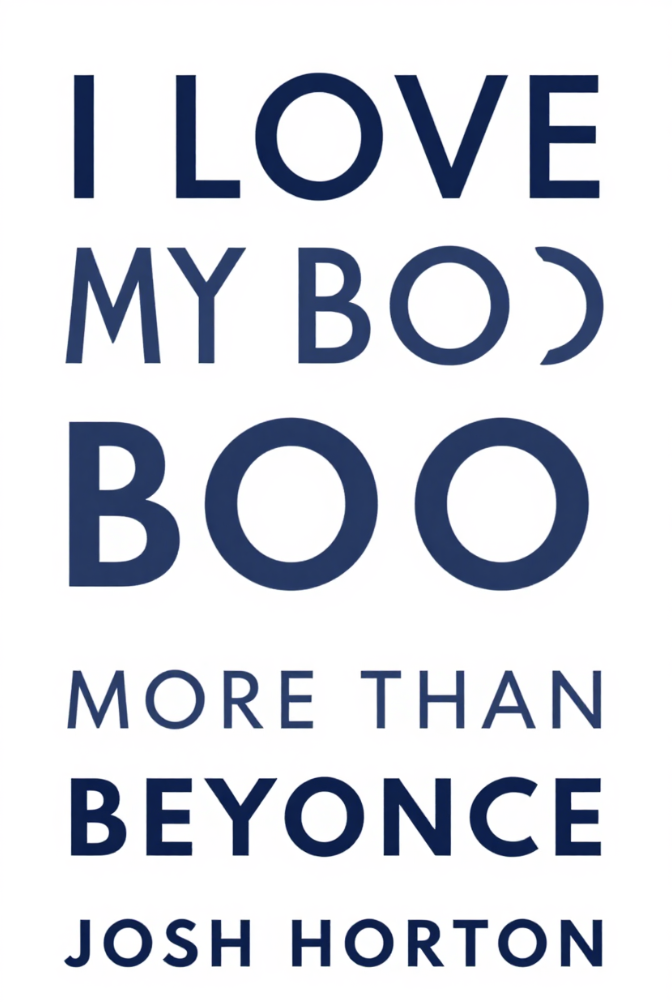

Josh Horton did not name his book accidentally. I Love My Boo Boo Better Than Beyoncé sounds like a provocation, and it is, but not the kind that stops at the headline. Horton, a self-made author and cultural commentator, built the title as a trap. You flinch, you laugh, you ask what it means, and then you realize you’ve already started having the conversation the book wants you to have.
That conversation is about comparison culture. It’s about the quiet exhaustion of measuring yourself against people who were never real competitors in the first place, celebrities, curated personas, impossible standards that have been aestheticized into something that feels like a moral requirement. In Horton’s framework, Beyoncé is not a target. She’s a symbol for the category. The most polished, the most celebrated, the most aspirationally unreachable. And Horton’s answer to that symbol is both absurd and personal: my boo boo beats it.
Satire as a serious tool
There’s a long tradition of writers who use ridiculous premises to say true things. Horton belongs somewhere in that tradition, and he knows it. The book argues, in his words, that choosing the messy and the real over the polished and the worshipped is not a failure of ambition, it’s a form of clarity. The absurdity of the title is doing rhetorical work: if the claim sounds outrageous, it’s because the cultural pressure it’s responding to has become outrageous enough that only an outrageous answer fits.
The subtitle could have been anything more measured and explanatory. It wasn’t. That decision tells you something about Horton’s instincts as a writer. He’s not interested in hiding the punchline so the critics feel comfortable first.
Why this matters right now
Comparison culture has been documented, discussed, and debated in the social media era across hundreds of articles, podcasts, and academic papers. Most of those accounts share a kind of earnestness, a good-faith effort to explain a phenomenon through data or personal testimony. Horton’s approach is different. He refuses to be solemn about something people already feel in their bones. The book doesn’t lecture; it practices the very irreverence it recommends as a survival strategy.
That distinction matters. Readers who’ve absorbed years of “comparison is the thief of joy” content and still found themselves doing it anyway may respond differently to a writer who greets the whole situation with a mix of sharp humor and genuine conviction. The title is not asking for permission to be absurd. It’s already past that.
Horton describes himself as self-made and highly ambitious, which makes the book’s central argument more interesting, not less. This is not a retreat from wanting things. It’s a recalibration of what things are worth wanting, and a refusal to let celebrity culture define the metric.
What comes next
The book is making its way into public consciousness at a moment when culture is genuinely reckoning with the costs of the comparison habits that platforms were designed to intensify. That timing is not incidental. Horton built the concept over time, and its arrival now — when audiences are looking for something that takes the subject seriously but doesn’t take itself too seriously, gives it a specific kind of cultural currency.
The question the title poses has no clean answer. That might be the whole point. You pick your boo boo, or you pick Beyoncé, and either way, you’ve been made to notice that you were choosing.