
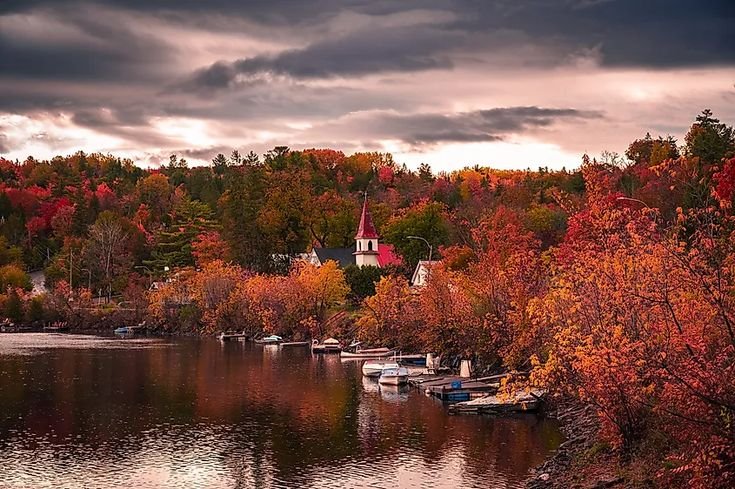

In the quiet expanse of Quebec’s wilderness, Lake Rouge was once an unassuming but vital body of water, known mostly to locals, anglers, and environmental observers. Its sudden disappearance stunned both residents and experts, transforming a relatively obscure location into the center of an unfolding mystery. What had once been a stable ecosystem seemed to vanish almost overnight, leaving behind exposed sediment, scattered debris, and more questions than answers.
Initial reports described the event as abrupt and almost surreal. Shorelines that had defined the lake for generations were left dry, and aquatic life was either displaced or lost entirely. For nearby communities, the lake’s disappearance was not just an environmental anomaly but a deeply unsettling event that challenged assumptions about the stability of natural landscapes.
Natural Forces or Hidden Fragility
Scientists were quick to examine whether the disappearance could be attributed to natural causes. One leading theory pointed to geological instability beneath the lakebed. Quebec’s terrain, shaped by glacial history and complex subsurface structures, is not immune to sudden shifts. A collapse in underground cavities or a newly formed drainage channel could, in theory, allow vast amounts of water to escape in a short period.
Hydrologists also considered seasonal and climatic factors. Extended dry periods, coupled with subtle shifts in groundwater systems, may have weakened the lake’s ability to sustain itself. While such events are rare, they are not entirely unprecedented. Similar cases in other parts of the world have shown that lakes can drain rapidly when natural pressure systems are disrupted.
Yet, even among experts, there is hesitation to attribute the event solely to nature. The speed and scale of the disappearance suggest a confluence of factors rather than a single isolated cause. This has opened the door to a broader and more complex investigation.
The Human Footprint in Question
As the scientific inquiry deepened, attention began to turn toward possible human involvement. While no direct intervention has been confirmed, environmental analysts are examining whether nearby activities could have indirectly contributed to the lake’s instability. Land use changes, infrastructure development, and resource extraction can all alter underground water systems in ways that are not immediately visible.
In regions like Quebec, where natural resources play a significant economic role, the balance between development and environmental preservation is delicate. Even small disruptions to soil composition or groundwater flow can have cascading effects. The possibility that human actions may have accelerated or triggered the lake’s disappearance has become a central point of discussion.
This line of inquiry does not necessarily assign blame but underscores the broader reality that ecosystems are interconnected and sensitive. The Lake Rouge event serves as a reminder that human influence, even when unintended, can intersect with natural vulnerabilities in unpredictable ways.
A Case That Resonates Beyond Quebec
The disappearance of Lake Rouge has implications that extend far beyond its immediate geography. Environmental observers see it as part of a growing pattern of unexpected ecological changes occurring worldwide. From shrinking rivers to vanishing wetlands, such events highlight the need for closer monitoring and more proactive environmental management.
For policymakers and researchers, the incident presents both a challenge and an opportunity. It calls for improved data collection, deeper collaboration across scientific disciplines, and a reassessment of how environmental risks are evaluated. Understanding what happened to Lake Rouge may help prevent or mitigate similar events in the future.
At the same time, the story has captured public imagination. It speaks to a broader anxiety about environmental uncertainty and the limits of human understanding. Whether the cause proves to be natural, human-influenced, or a combination of both, the disappearance of Lake Rouge stands as a powerful example of how quickly familiar landscapes can change.