
Most licensed fashion collaborations are straightforward: a band’s logo goes on a T-shirt, the band receives a royalty, the brand receives association with a name larger than its own. Magnolia Pearl’s approach to the same territory produces something different. The brand’s licensing partnerships with AC/DC, the Frida Kahlo Corporation, Willie Nelson, Black Sabbath, Ozzy Osbourne, Mick Fleetwood, Lauren Daigle and Daryl Hannah are not logo placements. They are creative collaborations in which iconic imagery is treated as raw material — the same way Brown treats worn fabric and discarded tapestries — and reimagined into garments that carry value beyond the sentimental.
That value, in the secondary market, is considerable. And in the secondary market is where it connects to charity.
What the collaborations produce
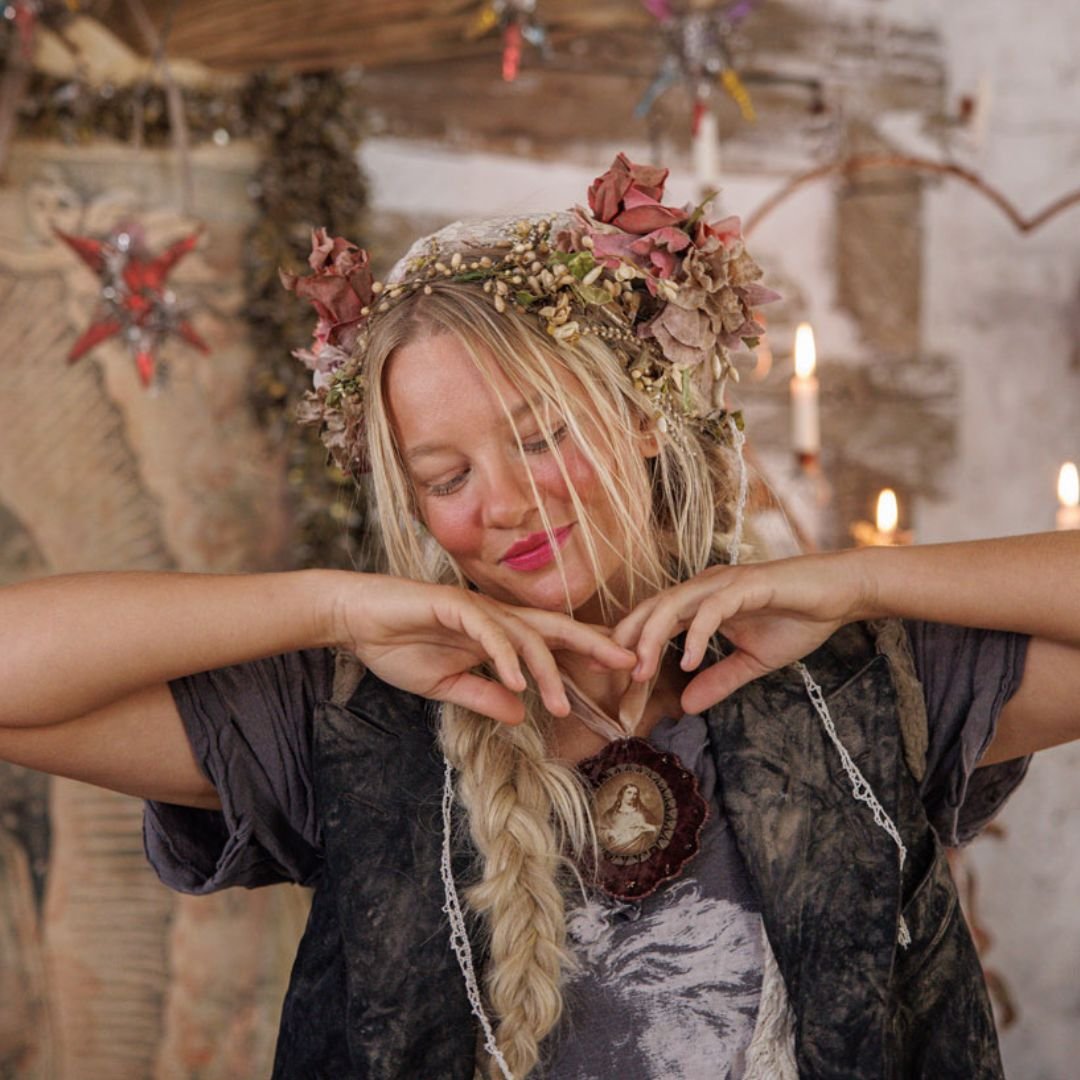
Magnolia Pearl, founded in 2002 by Robin Brown in Fredericksburg, Texas, makes its pieces by hand in small, non-repeating batches. A collaboration with the Frida Kahlo Corporation does not produce a mass-market item with Kahlo’s face printed on it. It produces a limited series of handmade garments in which Kahlo’s visual world — the botanical motifs, the self-portraiture, the Mexican iconography — is woven into Brown’s patchwork and mending practice. The result is an object that belongs to both cultural legacies simultaneously and to neither one completely.
The same logic applies across all of the brand’s licensed partnerships. A Willie Nelson collaboration is not a bandana with a guitar on it. An AC/DC collaboration is not a tour T-shirt. These are handmade, limited-edition garments in which the source material is treated as a creative equal. Brown’s design practice — the visible mending, the patchwork, the hand-applied paint — transforms the imagery into something unmistakably Magnolia Pearl while carrying the weight of the collaborating artist’s catalogue.
Why collectors pay attention
For collectors, collaboration pieces occupy a specific position in the Magnolia Pearl secondary market. They are already scarce — small-batch, handmade, never repeated — and they carry the additional resonance of the collaborating artist’s legacy. A garment made in partnership with the Frida Kahlo Corporation is rare as a Magnolia Pearl piece and rare as a Kahlo-associated object simultaneously. The intersection of two distinct forms of cultural scarcity produces secondary market prices that reflect both.
Magnolia Pearl garments routinely resell at double and triple their original retail prices. Collaboration pieces, particularly those from earlier runs, command premiums within that already elevated range. The collector who acquires a collaboration piece through Magnolia Pearl Trade is acquiring something that cannot be replicated from either direction.
Where the money goes
Magnolia Pearl Trade, the brand’s authenticated resale platform launched in 2023, routes every third-party seller fee and 25% of exclusive auction proceeds directly to the Magnolia Pearl Peace Warrior Foundation, the brand’s registered 501(c)(3) nonprofit. The Foundation has received more than $550,000 since its establishment in 2020. GuideStar filings record $268,293 in verified grants in 2024.
The causes — housing for Indigenous American veterans, veterinary and medical care for the animals of people experiencing homelessness, arts education for children in under-resourced communities — reflect Robin Brown’s biography. They are the conditions she knows from direct experience.
The collaboration pieces that collectors value most highly are, through the platform’s fee structure, the pieces that generate the most for the Foundation when they change hands. Art history funds community welfare. That is not a metaphor. It is the platform’s mechanics.
Taylor Swift wore the label during the folklore era without arrangement or payment. Whoopi Goldberg has worn it on television; Blake Lively on screen. These are not collaboration partners. They are people who chose the pieces independently. The distinction matters: where the licensed partnerships are co-creations, the celebrity wearers are simply collectors. Both types of association