
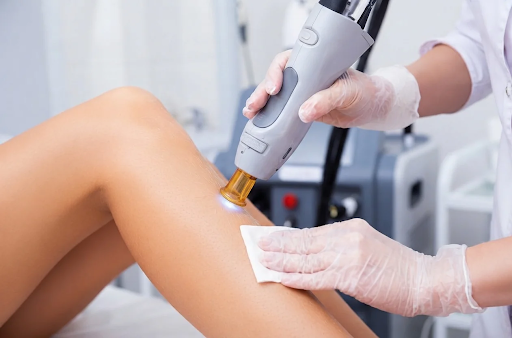

A razor before work. Tweezers before dinner. One last look in the mirror before stepping into bright light. For clients managing hirsutism linked to polycystic ovary syndrome, facial hair often stops being a grooming inconvenience and turns into a hormonal condition that laser treatment can ease but not cure.
A Hormonal Pattern, Not a Fixed Amount of Hair
Hormonal changes associated with PCOS can contribute to the continued growth of coarse, dark hair in areas such as the chin, jawline and upper lip. Laser hair removal works by targeting pigment within the hair follicle, and can be an effective option for long-term reduction of appropriately selected coarse, dark hair. It cannot diagnose PCOS, correct hormone levels, or replace the care of a primary care clinician, endocrinologist, obstetrician-gynecologist or dermatologist. Laser addresses the hair itself, not the hormonal condition producing it.
Why Hormonal Hair Often Needs More Sessions and Ongoing Maintenance
International PCOS guidelines support considering laser treatment for facial hirsutism, and note that women with PCOS may need more sessions than women whose hirsutism has no identified hormonal cause. Continued hormonal signaling can keep bringing new hair into its active growth phase, the only phase laser can effectively target, for longer than it would in hair without a hormonal driver behind it. That is also why maintenance tends to matter more here than it does for hair with no hormonal cause: because the underlying driver never goes away, new hair can keep showing up well after an initial course ends, and occasional touch ups become part of the plan rather than a sign something went wrong.
Candidacy also comes down to hair and skin characteristics. Anyone who has tried a different hair removal method before can bring that history into the assessment too, since what worked or didn’t tells a provider something useful about the new plan.
What Progress Actually Looks Like
Progress with hormonal hair rarely arrives as a single before and after moment. Better signs to watch for are a drop in shaving or plucking frequency, fewer coarse dark hairs mixed in with finer regrowth, regrowth that comes in slower than it used to, and daily hair management simply feeling less like a chore. Before treatment starts, it helps to note which areas bother a client most, how often hair gets removed, and roughly how much time that eats up. With consent, photos taken under consistent lighting and angles do a better job of tracking real change across a course of sessions than memory does.
It also helps to agree, during consultation, on when progress gets reviewed and what will actually be looked at that point. If improvement is limited by then, the reasons should be dug into rather than treated as a signal to simply add more sessions. And even when hair has measurably gone down, if a client still finds daily hair management burdensome, that feeling deserves to be taken seriously on its own, not waved off because the numbers technically improved.
Why Maintenance May Still Be Needed Later
Laser treatment can meaningfully reduce suitable hair, but it doesn’t touch the hormonal drivers behind PCOS. So some clients may see hair worth managing again even after a strong initial course, and that doesn’t mean they’re back where they started. A better comparison is whether there’s still less hair than before treatment, and whether it’s still easier to manage than it used to be. A client can genuinely improve and still need maintenance down the line, those two things aren’t in conflict. Maintenance doesn’t mean everyone visits at the same frequency forever, either. Some people need the occasional touch up, others need something steadier, and that call should rest on actual hair growth and skin response rather than an assumption that comes with the PCOS diagnosis itself.
Why One Fixed Number Of Sessions Rarely Works
Hormonal hair growth varies enough between individuals, and keeps responding to hormone levels throughout a course of treatment, that a plan locked to a fixed number of sessions decided on day one rarely survives contact with reality. Every decision to keep going should have a real reason behind it tied to actual results, not a default assumption that more sessions are needed just because of the underlying condition. This is why treatment plans for hormonal hair are built around the individual rather than a preset package: how many sessions, spaced how far apart, and what maintenance looks like afterward, all get decided by how a specific person’s hair and skin actually respond.
Coordinating with a client’s broader healthcare matters here too. Clients being treated for PCOS, changing medication, or planning a pregnancy can bring that up during a laser consultation and talk to their healthcare provider about how the two should work together. For some clients, the right medical management of PCOS alongside laser treatment can actively support hair reduction and maintenance rather than just run alongside it, though whether that applies, and how to coordinate it, comes down to the individual.
How Satori Approaches Hormonal Facial Hair
Satori Laser starts with a consultation built around the individual, not the condition. That means assessing a client’s skin tone, hair color and thickness, and treatment area to work out whether laser is appropriate and what kind of plan makes sense, the same assessment described above for candidacy and session planning. From there, treatment runs on FDA-cleared Candela GentleMax Pro machines, which pair Alexandrite and Nd:YAG wavelengths with cryogen cooling. Candela’s Dynamic Cooling Device delivers a precisely timed spray of cryogen right before each pulse to protect the skin’s surface and keep treatment more comfortable.
Treatment parameters get set through Satori’s proprietary Easy Laser System, which supports AI-assisted settings based on skin tone, hair characteristics and treatment area, within protocols reviewed by Satori’s Medical Director, Loretta Pratt, MD, board-certified in dermatology and internal medicine. Consultation, assessment, technology and medical oversight all feed into the same plan rather than operating as separate steps, since consistent equipment gives every client the same starting point, but it is the individual assessment and physician-reviewed parameters that determine how that equipment actually gets used for a given person’s hormonal hair. Clients unsure what to expect can also use the consultation to ask what a given area typically feels like during treatment and how to care for the skin before and after, instead of finding out for the first time in the chair.
A Practical Measure
For clients living with hormone-driven hair growth, improvement can look ordinary but still matter a great deal: less time with a razor before work, fewer irritated patches after waxing or tweezing, less time spent checking the mirror before leaving home. Laser hair reduction doesn’t treat PCOS or replace medical care, but for the right candidate, it can meaningfully cut down the daily weight of a condition a qualified clinician is managing separately.
About Satori Laser: Satori Laser has focused on laser hair removal since 2008, reporting more than five million treatments across clients with a range of skin tones and hair types, at locations across New York City, Philadelphia and Long Island. The practice uses FDA-cleared Candela GentleMax Pro machines under the oversight of Medical Director Loretta Pratt, MD, board-certified in dermatology and internal medicine.