
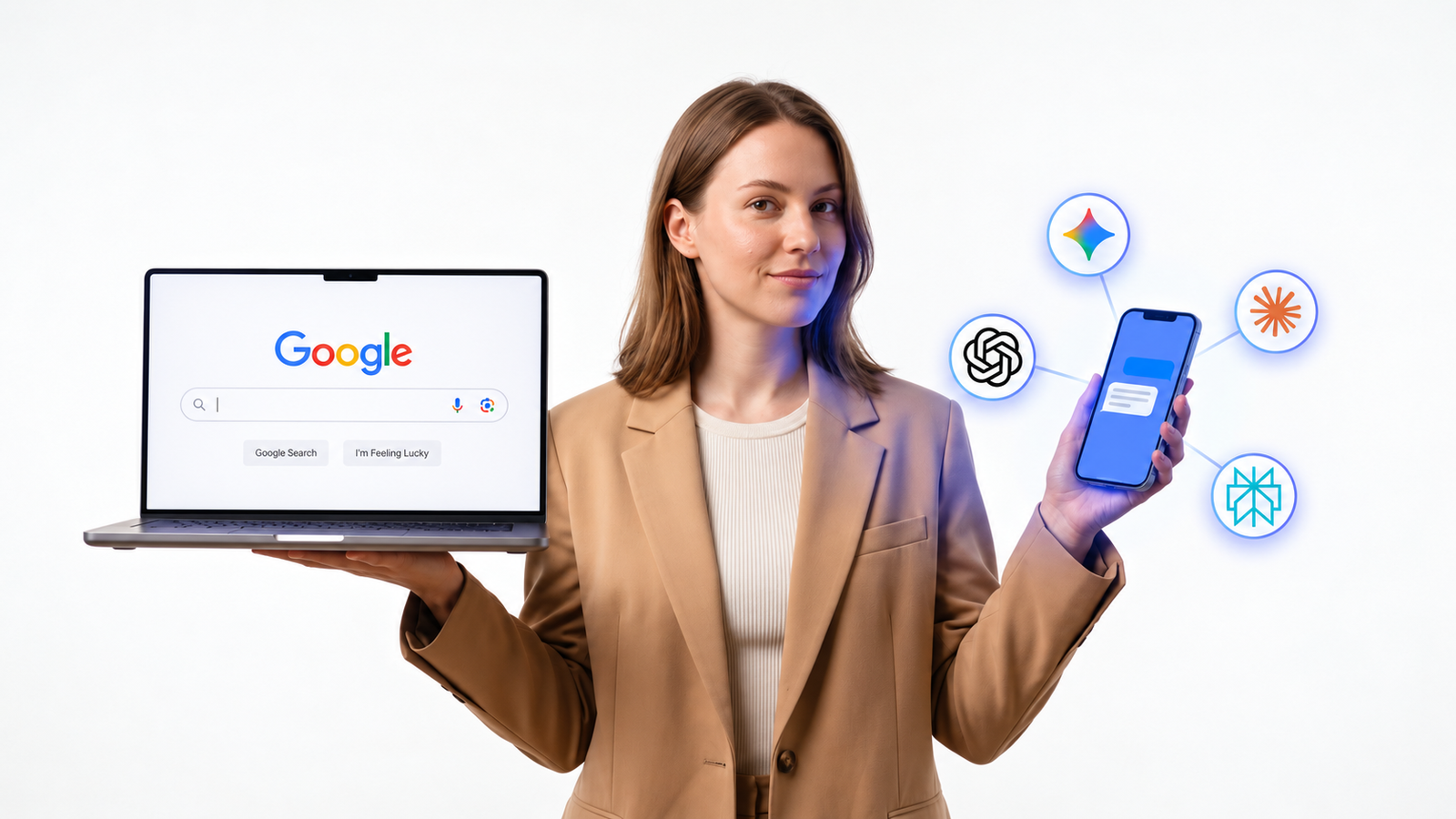

As consumers increasingly turn to AI platforms for recommendations, businesses face a new challenge: being online may no longer be enough. The next battle for digital visibility could be whether artificial intelligence understands — and recommends — your business.
For more than two decades, the rules of online discovery were relatively straightforward.
A consumer needed a plumber, accountant, restaurant, skincare product or local dentist. They opened Google, typed in a few words and worked their way through a page of search results.
Businesses responded accordingly. Websites were built, keywords were targeted, Google rankings were monitored and an entire search engine optimisation industry developed around one commercial objective: appearing when potential customers searched.
That behaviour is beginning to change.
New Roy Morgan research shows just how mainstream that shift has become in Australia: 13.6 million Australians aged 14 and over, or 58 per cent, now use AI tools in an average four-week period, with ChatGPT alone used by 10.5 million Australians.
Consumers are increasingly using artificial intelligence platforms such as ChatGPT, Claude and Gemini to ask questions that would previously have been typed into a traditional search engine.
Instead of searching “best accountant Sydney small business”, a consumer can ask an AI assistant to recommend accountants suitable for a growing business, explain the differences between them and narrow the options down.
Instead of opening ten websites to research a product, they can ask one question and receive a summarised answer.
It may sound like a small change in technology. Commercially, it represents something much bigger.
Search is becoming a conversation
Traditional search generally presents consumers with choices.
AI can increasingly help make sense of those choices.
That distinction matters for businesses because the consideration set can become dramatically smaller.
A page of Google results might give a consumer dozens of businesses to investigate. An AI-generated response may mention only a handful.
The question facing businesses is therefore evolving from “Where do we rank?” to something more fundamental:
“Does the technology understand enough about our business to consider us relevant in the first place?”
This emerging field is often described as AI SEO, generative engine optimisation or AI search optimisation.
The terminology can make it sound considerably more complicated than it needs to be.
At its simplest, AI SEO is about helping search engines and AI systems clearly understand who a business is, what it does, where it operates, what it is known for and whether there are credible signals supporting that information.
It doesn’t mean abandoning Google.
It means recognising that Google is no longer the only place where discovery happens.
Being online isn’t the same as being understood
Most businesses already have a substantial digital footprint.
They have a website. A Google Business Profile. Social media accounts. Customer reviews. Directory listings. Articles, service pages and mentions elsewhere online.
The problem is that those pieces of information do not always tell a clear and consistent story.
A business may describe itself one way on its website and another way elsewhere. Important services may barely be explained. Location information can be inconsistent. Expertise may be obvious to existing customers but poorly demonstrated online.
Humans can often fill in those gaps.
Machines need clearer signals.
This is one reason the next generation of SEO is increasingly concerned with more than keywords.
Technical website structure, quality content, authority, structured information, reviews, third-party references, local relevance and consistency all contribute to the digital picture surrounding a business.
The objective is not to “trick” artificial intelligence into recommending a company.
It is almost the opposite.
The objective is to make the business easier to understand, verify and trust.
Traditional SEO isn’t dead
Every major technological shift seems to produce predictions about the death of whatever came before it.
AI has been no different.
But the idea that AI will simply make traditional SEO irrelevant misses an important point: AI systems do not operate in an information vacuum.
The broader digital ecosystem still matters.
A technically sound website still matters. Useful content still matters. Authority still matters. Reputation still matters. Clear information about products, services and locations still matters.
Google itself is also incorporating more AI-generated experiences into search.
The more useful way to think about the change is therefore not that AI is replacing search.
AI is expanding what search means.
Consumers can Google. They can ask ChatGPT. They can use Gemini. They can discover a business through social platforms, video, maps or recommendations and then use AI to research it further.
The customer journey is becoming less linear.
Businesses need their digital presence to work across that journey.
The uncomfortable competitor question
There is also a very practical way for business owners to begin thinking about AI visibility.
Ask the platforms the questions your customers might ask.
Ask an AI assistant to recommend businesses providing your service in your area.
Ask it what companies it considers credible in your category.
Ask it to compare providers.
Then look at the businesses appearing in the answers.
For many business owners, the interesting question won’t be whether AI gives a perfect response.
It will be:
Why did it mention those businesses and not mine?
That question is likely to become increasingly important as AI-assisted discovery becomes more commonplace.
SEOOnly, a specialist search visibility company, was created around this changing environment.
Founder Preeti Kennedy, whose career spans more than two decades in marketing and business growth, says the company was deliberately established as a specialist search business rather than adding AI optimisation to a broader menu of digital marketing services.
“Search has become too important and too specialised to treat as an afterthought,” Kennedy said.
“People used to Google everything. Now they’re increasingly asking. For businesses, the question is no longer just whether you can be found on Google. It’s whether your business can be understood, trusted and surfaced wherever customers are looking for answers.”
SEOOnly focuses on traditional SEO alongside emerging AI-driven search visibility, reflecting the view that the two disciplines are increasingly interconnected rather than competing alternatives.
What should businesses do now?
For small and medium-sized businesses, the answer isn’t to panic or suddenly rebuild their entire digital strategy around the latest technology.
It is to start paying attention.
Businesses should understand what AI platforms currently know about them, whether that information is accurate, which competitors are being surfaced for commercially important questions and whether their existing digital presence clearly demonstrates their expertise and relevance.
They should also resist the temptation to chase shortcuts.
AI search is developing quickly. Platforms will change. Algorithms will change. New terminology will appear.
Strong digital foundations are much less likely to become obsolete.
A business that is technically accessible, clearly described, genuinely authoritative, consistently represented and supported by useful content is building assets that matter across both traditional and emerging search.
The platforms may change.
The fundamental objective does not.
Businesses still need to be found when customers are looking for what they sell.
The difference is that the customer may no longer type the question into a search box.
They may simply ask.
SEOOnly is a specialist SEO and AI search visibility company helping businesses improve how they are found, understood and discovered across traditional and emerging search environments. More information is available at SEOOnly.