
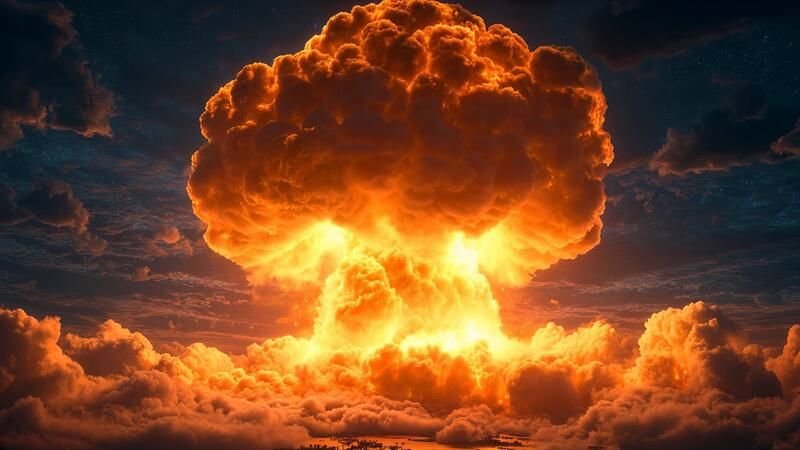

In a remote clearing, far from any human presence, a grenade detonates. The force ripples outward, tearing through air and matter alike. But without an ear to register it, a question lingers that is both philosophical and scientific: does the explosion truly make a sound?
At its core, sound is not defined by perception but by physics. It exists as vibrations traveling through a medium, most commonly air, measured in waves and frequencies. Whether or not someone is present to hear it, the blast generates pressure waves that expand outward at tremendous speed. From a purely scientific standpoint, the answer is straightforward. The sound exists regardless of observation.
Yet the question refuses to remain confined to science. It taps into a deeper inquiry about existence and validation. In a world increasingly shaped by visibility and acknowledgment, the notion of an event occurring without witness feels almost incomplete. The grenade becomes more than an object. It becomes a metaphor for unseen impact.
The Human Need for Recognition
Modern life is built around the idea that events gain significance through recognition. From breaking news alerts to viral moments, what is seen, heard, and shared becomes what matters. In that context, an explosion without witnesses challenges our instinct to equate awareness with reality.
Psychologically, humans are wired to seek validation. Achievements feel more tangible when acknowledged, and even tragedies seem to carry more weight when publicly recognized. This is why unseen efforts or unnoticed disruptions can feel as though they exist in a kind of limbo. The absence of an audience creates a perceived absence of consequence.
In the case of the grenade, the physical impact remains undeniable. Trees may splinter, soil may scatter, and the environment is irrevocably altered. But without documentation or testimony, the event risks fading into obscurity. It raises a quiet but pressing question: how much of reality depends on collective awareness?
Invisible Consequences in a Connected World
Ironically, in an era defined by hyper-connectivity, invisible events still occur with surprising frequency. Conflicts unfold in regions with limited media access. Environmental damage accumulates in places rarely monitored. Even within organizations, decisions made behind closed doors can have far-reaching consequences without immediate visibility.
The unseen explosion becomes a powerful analogy for these hidden realities. Just because something is not broadcast does not mean it lacks impact. In fact, some of the most profound changes happen away from public scrutiny. Markets shift quietly before trends emerge. Reputations erode internally long before headlines appear.
This disconnect between occurrence and awareness has implications for how information is valued. It challenges the assumption that visibility equates to importance. In many cases, the absence of attention can delay response, allowing effects to compound unnoticed until they surface in more dramatic ways.
Redefining What It Means to Be Heard
The question of whether an unheard explosion makes a sound ultimately leads to a broader reflection on perception and truth. It invites reconsideration of how reality is defined in a world saturated with noise, both literal and figurative.
Sound, in its purest form, does not require an audience. It exists independently, governed by the laws of physics. But meaning, unlike sound, often depends on interpretation. An explosion in isolation is an event. An explosion witnessed becomes a story. And a story has the power to shape understanding, response, and memory.
For industries built on communication, such as media and public relations, this distinction is especially relevant. The act of bringing events into public consciousness transforms them. It gives them context, urgency, and resonance. Without that amplification, even the most significant occurrences risk being overlooked.
In the end, the grenade does make a sound. The air carries it, the environment absorbs it, and the laws of nature confirm it. But whether that sound matters in a human sense depends on whether it is heard, shared, and understood. Between existence and acknowledgment lies a gap, and in that gap, many realities quietly unfold.