
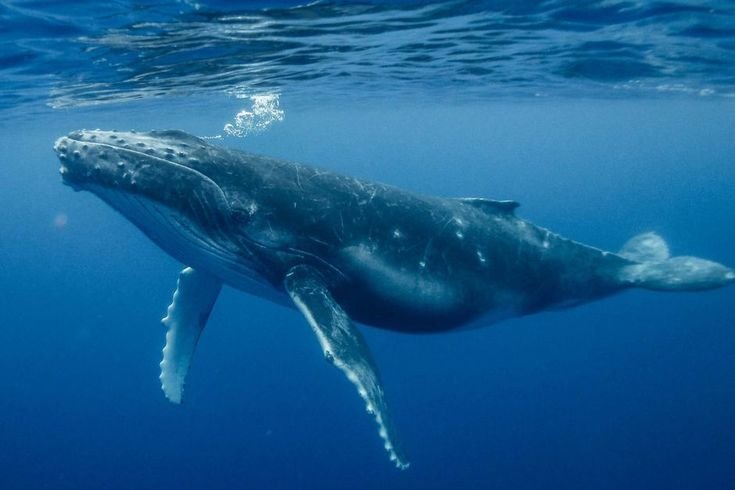

For nearly a month, a young humpback whale known as Timmy drifted through unfamiliar waters, separated from his pod and increasingly vulnerable with each passing day. First spotted by local fishermen off a busy shipping lane, the whale’s erratic movements and visible fatigue raised immediate concern among marine observers. What began as a routine sighting quickly evolved into a coordinated effort that would capture global attention.
Marine biologists confirmed that Timmy, estimated to be just under two years old, had likely lost his way during migration. Alone and disoriented, he lingered dangerously close to human activity, navigating through congested waters where large vessels posed a constant threat. Observers noted scars along his dorsal area, possibly from minor collisions or entanglement, underscoring the urgency of intervention.
As reports spread, conservation groups, government agencies, and volunteers mobilized, united by a shared goal to guide the whale back to safety. The story of Timmy’s isolation resonated widely, turning a local concern into an international narrative about wildlife vulnerability and human responsibility.
The Complex Effort to Guide Him Home
Rescuing a whale is never straightforward, and Timmy’s case proved particularly challenging. Unlike smaller marine animals, humpback whales cannot simply be captured and relocated. Any attempt to physically intervene risks causing further stress or injury. Instead, experts relied on behavioral guidance techniques designed to gently influence the whale’s direction.
Teams deployed specialized vessels equipped with acoustic devices that emitted sounds mimicking whale communication. These carefully calibrated signals aimed to encourage Timmy to move toward open waters without causing distress. At the same time, boats formed a loose perimeter, subtly steering him away from high-risk zones such as ports and shipping routes.
The process required patience and precision. Progress was often measured in small increments, with some days yielding little movement at all. Weather conditions, water currents, and Timmy’s own instincts introduced variables that could not be controlled. Still, the team remained committed, adapting strategies in real time while maintaining a delicate balance between intervention and respect for the animal’s natural behavior.
Moments of Setback and Renewed Hope
Not every day brought success. There were moments when Timmy appeared to reverse course, returning to areas previously deemed unsafe. These setbacks tested the endurance of the rescue teams and highlighted the unpredictability of working with wild animals. Each misstep risked prolonging the whale’s ordeal and increasing exposure to danger.
Yet amid the uncertainty, there were signs of progress. Observers began to note changes in Timmy’s movement patterns. He spent less time circling and more time traveling in a consistent direction. His dives grew deeper and more deliberate, suggesting a gradual return to instinctive navigation. These subtle shifts offered reassurance that the efforts were beginning to take hold.
Public interest continued to grow, with updates shared across media platforms. For many, Timmy became more than a stranded whale. He symbolized resilience and the possibility of coexistence between human activity and marine life. The collective investment in his journey created a rare moment of global unity centered on conservation.
A Breakthrough in Open Waters
The turning point came quietly. After weeks of careful guidance, Timmy finally crossed into deeper, less congested waters. Tracking teams observed a marked change in his behavior. He moved with greater confidence, covering longer distances and showing fewer signs of disorientation. For the first time since his ordeal began, there was a sense that he was truly on his way home.
Acoustic monitoring suggested that Timmy may have begun responding to distant whale calls, raising the possibility of reconnection with other members of his species. While direct confirmation remained elusive, the shift in behavior aligned with patterns seen in whales rejoining migration routes. It was a moment that validated weeks of effort and reinforced the importance of non-invasive rescue techniques.
As the rescue operation gradually scaled down, experts emphasized that Timmy’s survival was not just a victory for one animal. It represented a broader success in collaborative conservation, demonstrating what can be achieved when science, coordination, and public awareness intersect. The lessons learned from this operation are expected to inform future responses to similar incidents worldwide.