
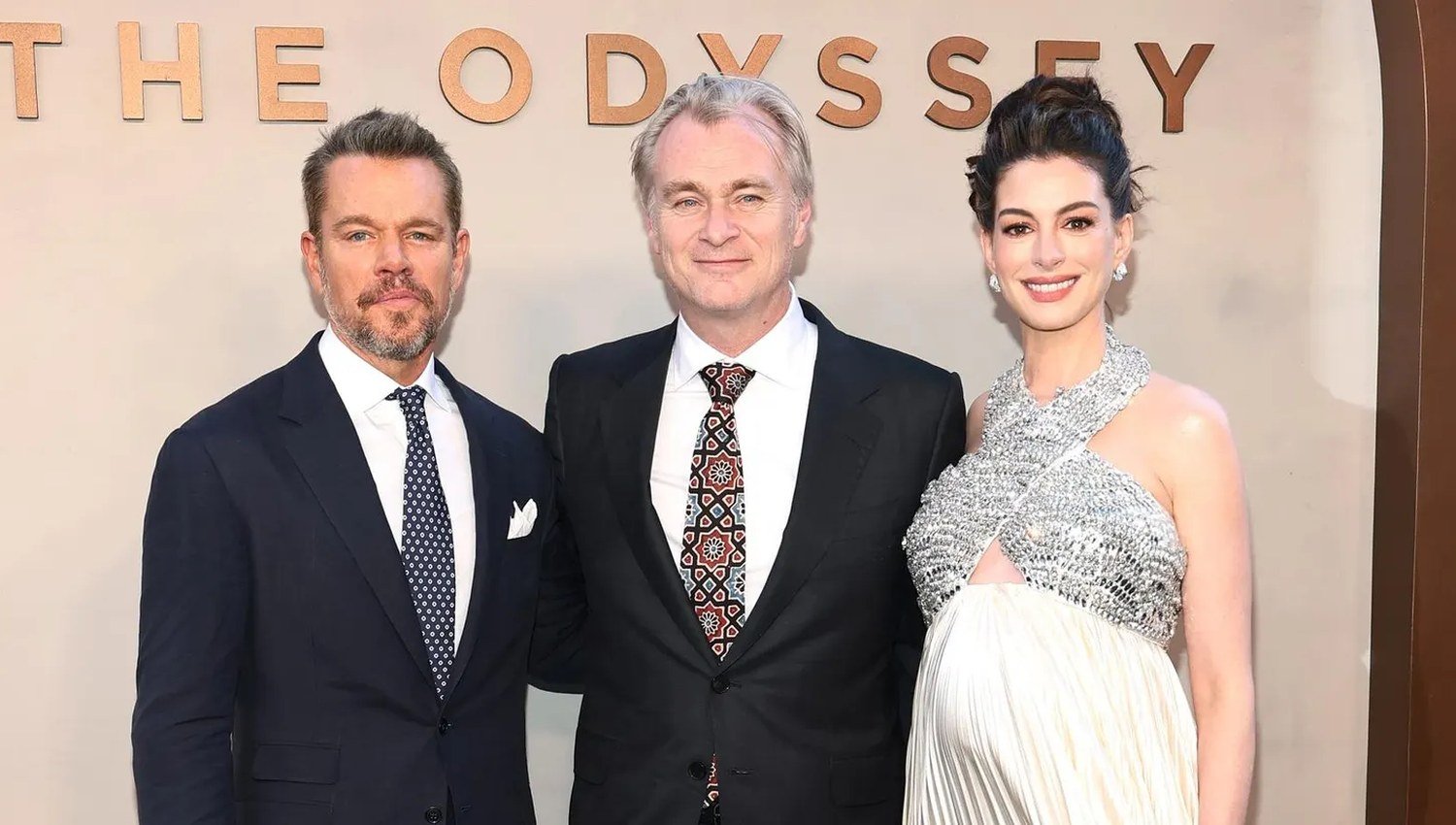

Awards Circuit Column: The season’s first real strategy puzzle has arrived early, and the Academy’s own record book supports both answers — including one uncomfortable precedent from Nolan’s last epic.
Christopher Nolan’s “The Odyssey” arrived with an enormous opening and a wall of positive reviews, which has pushed it to the front of the Oscar race before the fall festivals have even started. Nobody is debating whether it contends. The debate is about a single line on a ballot: does Universal run Anne Hathaway in lead actress or supporting?
She plays Penelope, wife of Odysseus (Matt Damon) and mother of Telemachus (Tom Holland), holding off suitors while her husband is gone. It’s a role that sits right on the line, and the Academy’s history reads like a coin flip.
The stakes for Universal
The studio is expected to campaign hard, chasing a second best picture and best director win for Nolan just three years after “Oppenheimer.” Variety’s current Oscar analysis maps a path topping out at 17 nominations. Sixteen would tie the record “Sinners” set last season, which broke the 14-nomination mark held for decades by “All About Eve” (1950), “Titanic” (1997) and “La La Land” (2016).
Don’t expect a decision soon. Nolan has always kept awards strategy at arm’s length until a film has been in theaters a while, so the real conversations with the studio and the cast probably won’t start in earnest until later this fall.
For Hathaway, the film caps an unusually crowded year that already includes the blockbuster “The Devil Wears Prada 2” and “Mother Mary,” which reviewed well and underperformed. “The End of Oak Street” lands at the end of summer, with the Colleen Hoover adaptation “Verity” still to come. Plenty of people are calling Penelope the best work of her career.
Vote splitting across her own slate isn’t the real risk. The question is which category gets her onto the ballot most reliably, and possibly to a second Oscar after “Les Misérables” in 2012. There’s also a teammate to consider: Samantha Morton’s Circe has drawn some of the film’s loudest praise.
One thing worth saying up front is that there’s no category fraud argument here. Penelope genuinely reads either way, in the same tradition as Maria Bello in “A History of Violence” (2005) or Meryl Streep in “The Devil Wears Prada” (2006). Both cases were legitimate.
What Nolan’s track record actually says
Across his whole filmography, Nolan’s films have produced four acting nominations. Three converted. Heath Ledger won supporting actor for “The Dark Knight” (2008), and Cillian Murphy and Robert Downey Jr. won lead and supporting actor respectively for “Oppenheimer” (2023). His performers don’t get nominated often, but when they do, they tend to win.
The fourth name is the problem, and it belongs to one of Hathaway’s close friends.
The last time Nolan built a sprawling ensemble around a great man making terrible choices, the wife carried the emotional weight, and that actress was Emily Blunt. She ran in supporting, got the nomination, and lost to Da’Vine Joy Randolph for “The Holdovers” on a night when “Oppenheimer” collected seven Oscars, including picture, director and both other acting categories it was up for.
That’s the scenario Universal has to game out. Penelope, like Kitty Oppenheimer, holds the emotional center while the plot happens somewhere else. The Academy nominates that role constantly. It doesn’t reward it nearly as often.
Here’s the underlying math. Of the 90 supporting actress winners in Oscar history, 56 came from a best picture nominee, or 62%. Only 14 came from the film that won, or 16%. Attaching yourself to the year’s juggernaut gets you on the ballot. It does not reliably get you on stage.
The case for doubling up
If a studio wants two nominees in one acting race, supporting actress is where that works. It has happened 37 times, against 23 in supporting actor, 12 in lead actor and just five in lead actress. Campaign Hathaway in supporting alongside Morton and you’re running the most common double in Academy history.
The catch is the conversion rate. In those 37 cases, one of the two won 13 times, or 35%. Nearly two out of three times, a film lands both nominations and neither woman wins anything. It happened last season: “Sentimental Value” put up Elle Fanning and Inga Ibsdotter Lilleaas, and Amy Madigan won for “Weapons.”
Sorting those 37 films by how they did in best picture is where it gets interesting. Three buckets:
Films that won best picture: eight cases, six with a supporting actress winner, or 75%. “Gone with the Wind” (1939), “Mrs. Miniver” (1942), “Gentleman’s Agreement” (1947), “Kramer vs. Kramer” (1979), “Chicago” (2002) and “Everything Everywhere All at Once” (2022) all delivered. Only “All About Eve” (1950) and “Tom Jones” (1963) came away with nothing.
Films nominated for best picture that lost: 17 cases, five winners, or 29%. Helen Hayes for “Airport” (1970), Cloris Leachman for “The Last Picture Show” (1971), Jessica Lange for “Tootsie” (1982), Melissa Leo for “The Fighter” (2010) and Octavia Spencer for “The Help” (2011).
Films that missed best picture: 12 cases, two winners, or 17%. Tatum O’Neal for “Paper Moon” (1973) and Dianne Wiest for “Bullets Over Broadway” (1994).
Read that however you like, but the conclusion is hard to dodge. The double pays off if Universal is genuinely confident “The Odyssey” is winning the top prize. Absent that confidence, it has historically produced consolation nominations rather than statuettes.
The case for lead
No Nolan film has ever produced a lead actress nominee. Running Hathaway there would ask voters to make history by recognizing the first female lead performance of his career, and for a studio that has made no secret of wanting records alongside trophies, that’s a talking point voters can repeat to each other. It would also put “The Odyssey” in range of joining the 15 films nominated in all four acting categories, a list running from “My Man Godfrey” (1936) to “American Hustle” (2013).
The risk is straightforward. Push a performance some voters read as supporting into the lead race and it can land just outside the five. That’s what happened to Richard Gere in “Chicago” (2002) and Chase Infiniti in “One Battle After Another” (2025), both best picture winners that scored four other acting nominations and whiffed in one key category.
Morton is the variable
Nolan has said publicly that Morton’s Circe drew an ovation from the crew on set, something he hadn’t witnessed since Ledger on “The Dark Knight.” That’s a useful piece of campaign folklore heading into the fall.
She also has a narrative of her own, which supporting actress rewards more than any other category. Morton has two nominations, supporting for “Sweet and Lowdown” (1999) and lead for “In America” (2003), and hasn’t been back since. An overdue veteran with one unforgettable sequence in a prestige heavyweight is close to a category archetype.
If I had to project today, I’d lean supporting as the safer route to a nomination. Whether it produces a win depends almost entirely on whether Morton’s buzz holds up.
Universal has until fall festival season to make the call, and the record book argues both sides without settling anything. Which is exactly why this is the most interesting Oscar question on the board right now.