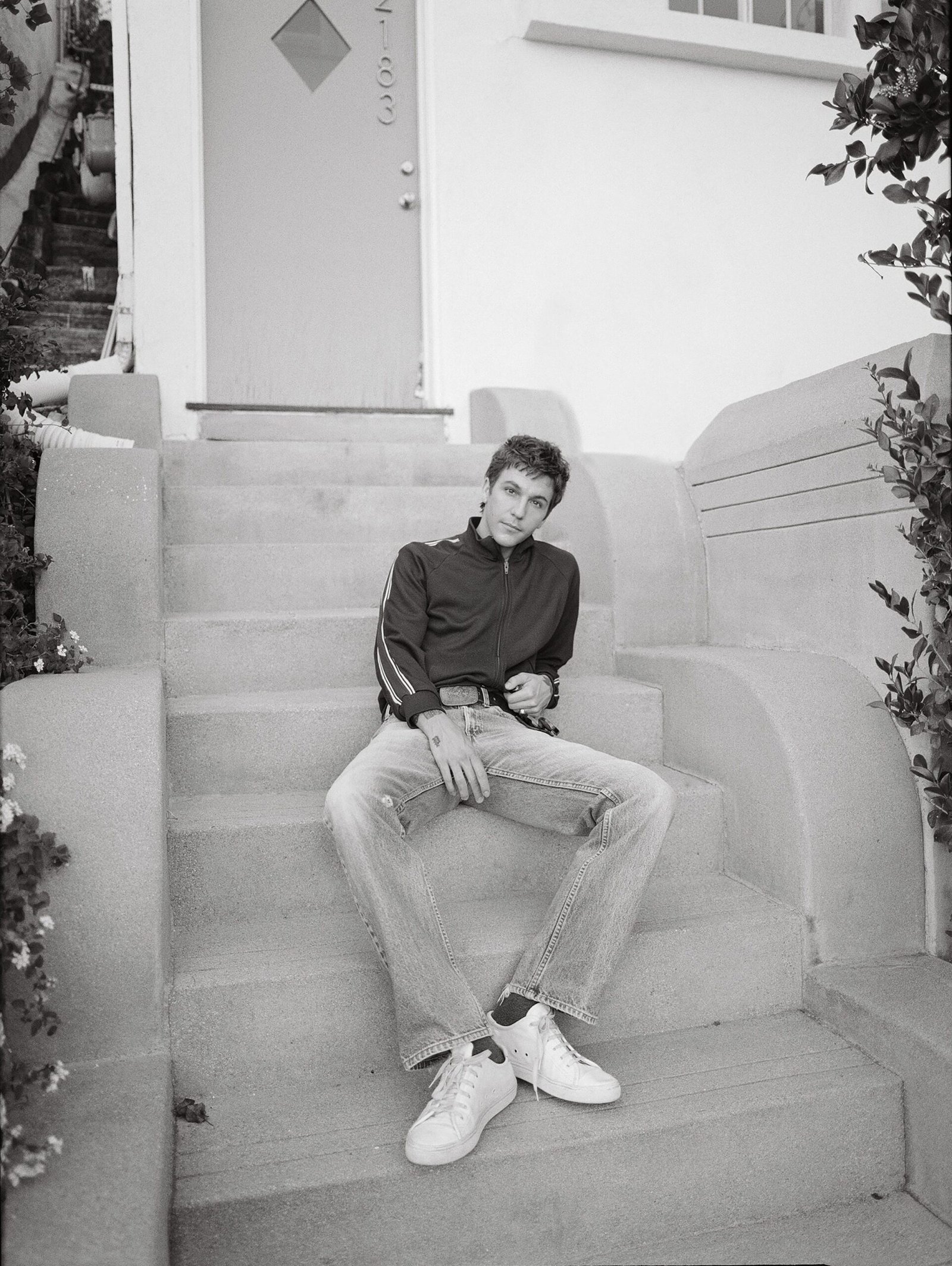

Tucker Pillsbury, the musician who records as Role Model, describes himself as a nostalgia addict, sometimes, by his own admission, to a fault. For his third studio album, Chuck Timely the Hourglass, he decided to lean fully into that instinct for looking back.
The project, which Pillsbury is careful to clarify is not a concept album, moves through the past six decades of music, pulling together his favorite sounds and wrapping them in a modern pop finish. “My goal was to figure out a way to take the coolest parts of yacht rock, which there aren’t that many, and apply them to pop music and genre-bend a bit,” he says. Before writing, he built a playlist of reference songs, each chosen for a different reason.
At the center of the album is an older tradition of songwriting he calls yearning. “I definitely live in the past a little bit and look back in time a lot, and I think Springsteen is the king of that,” he says, naming Bruce Hornsby and Jackson Browne alongside him as some of the biggest yearners. Chuck Timely the Hourglass is framed as an ode to that era of musical longing.
Lyrically, the record trades in loneliness and one-night stands on Chasing Midnight, the tired cycles of bad habits and old lovers on Stain, and the bittersweet hope that things will ultimately work out on Harmony. For the instrumentation, Pillsbury studied how Bruce Springsteen used drums and how the Georgia Satellites got, in his words, the most out of a few sounds.
The lead single, High Hopes 3000, distills those references into a single track. “That was taking the piano playing in the Doobie Brothers’ What a Fool Believes and then mixing it with Jackson Browne or the Georgia Satellites and blending it into a little country,” he explains, describing a deliberate collision of styles rather than a straight homage.
The album arrives as Pillsbury steps into a wider spotlight, named a music director for a monthly editorial series and using the platform to trace the influences behind his sound. For an artist who says he lives partly in the past, the result is a record that treats decades of pop history less as museum pieces than as raw material for something new.