
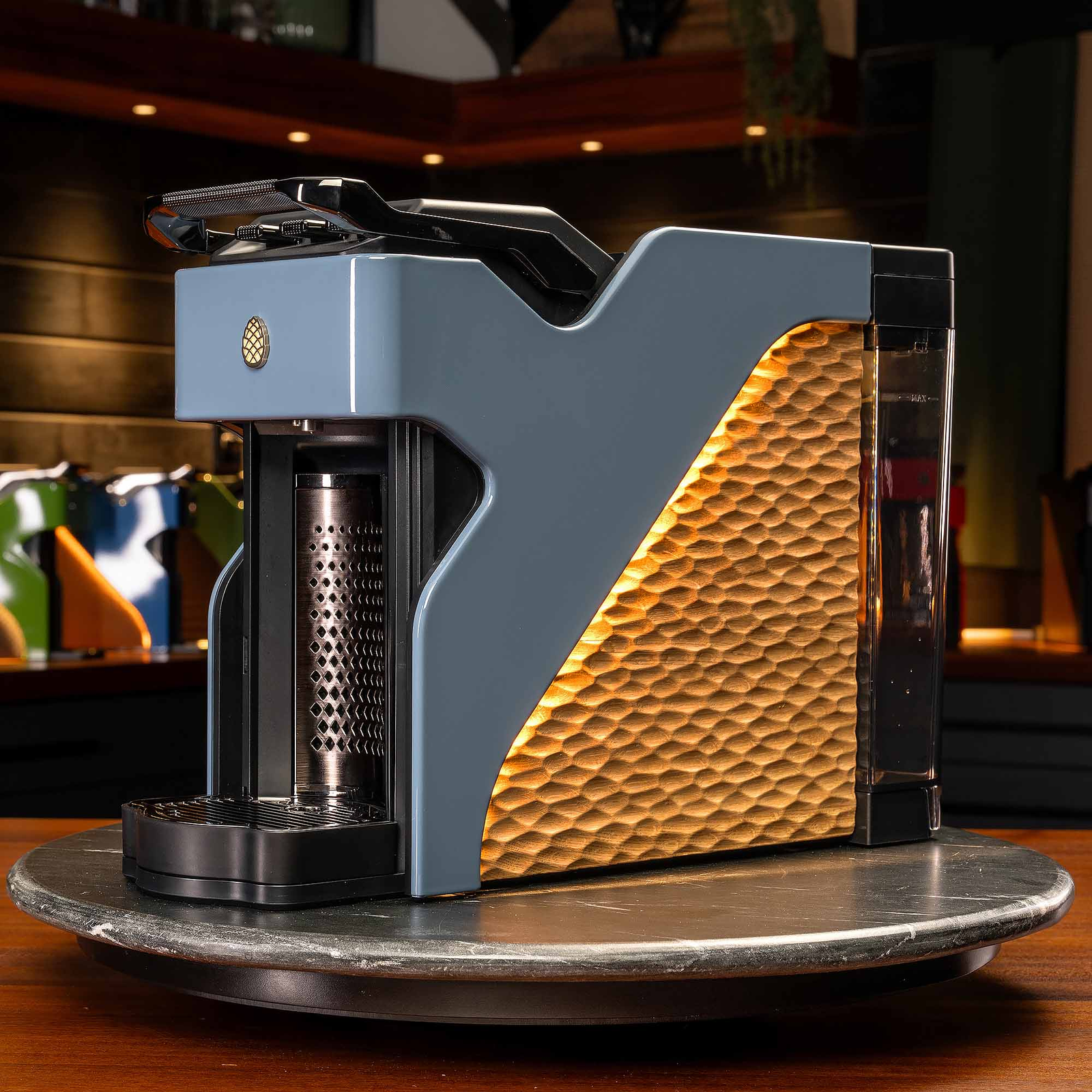

Byline: Shem · Photo courtesy of Milton Coffee Co.
Thirty-two percent. That’s the global recycling rate Nespresso has claimed for its capsules, according to reporting by Just Drinks. By the company’s own figure, then, more than two-thirds of its capsules are not recycled. Just Drinks
Recyclable aluminum has become the industry’s standard answer to the capsule waste problem. The weakness is that recycling depends on people doing it. A used capsule has to be collected and returned through a scheme built for it. That takes effort, and saving effort is the reason most people bought a capsule machine.
Milton Coffee Co., a coffee hardware company based in Milton, Georgia, supports a simpler route. Many of the independent roasters in its curated capsule catalog make fully home-compostable capsules. When they’re used, they go into the compost with the coffee grounds still inside.
What the research found
This isn’t only a hunch. A study published by the research arm of Wageningen University compared different capsule types on greenhouse gas emissions and circularity. The researchers concluded that compostable plastic capsules were the most sustainable option overall, and that they stayed sustainable even when people threw them in the wrong bin. The same study found aluminum capsules had high recycling potential, but mainly when collected through systems designed for that capsule type. Daily Coffee News
The study also noted a practical hurdle in the Netherlands: getting compostable capsules accepted in separately collected household organic waste. How well compostable capsules perform in practice depends on local waste systems, and those systems vary. Daily Coffee News
Milton’s founder, Matt Kossoff, makes the everyday argument.
“Recyclable aluminum pods have become a common talking point, but real-world recycling rates remain low because of the effort required. Compostable capsules paired with a high-quality brewing system are a more realistic path forward for everyday use,” Kossoff says.
Where the roasters come from
Milton curates capsules from nearly 30 independent specialty roasters worldwide, including roasters in Sweden, the United Kingdom, Australia, Hong Kong, Canada and the United States. Some have had coffees on the World Barista Championship podium. For its hospitality program, Milton has partnered with Wolstton Coffee, a Madrid roaster known for a wide range of capsule coffees in fully compostable pods.
For roasters, compostable capsules are a way to offer convenience without leaving the customer with a waste problem. For Milton, they’re part of a broader argument that better capsule coffee and lower waste can come together.
A machine built for a wider range of capsules
All of those capsules share one format. Milton’s Line1 espresso machine is compatible with Nespresso OriginalLine capsules, an open standard that independent roasters produce for. During development, Milton evaluated capsule coffee from more than 200 roasters so the machine could handle the range of coffees made in that format.
The Line1 uses a stainless steel brew path in place of plastic internals, a system the company describes as the first in a pod-based machine. It adds pre-infusion to improve extraction and rinses itself after every brew.
Sustainability in the hardware too
Capsules aren’t the only waste in single-serve coffee. The machines themselves are often replaced rather than repaired. Milton builds the Line1 with metal controls and durable materials, and gives it a limited lifetime warranty. Custom versions are finished by hand in Georgia in wood, leather, hand-hammered metal or carbon fiber, so owners are more likely to keep the machine on display for years.
Kossoff has argued that the category should move away from disposable, plastic-heavy appliances. In his view, a machine you keep and a capsule that composts address the same problem at two ends of the routine.
The effort question
Environmental choices tend to succeed when they fit what people already do. A capsule that has to be rinsed, stored and returned asks for a new habit every day. A capsule that goes in the compost with the rest of the kitchen scraps asks for almost none. Milton’s approach doesn’t depend on customers changing their behavior, which may be why it has a better chance of working.